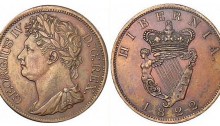
O’Brien Coin Price Guide 2016: The Irish Coinage of George IV
2016 Market Values Copper Penny Copper Halfpenny Copper Farthing <no image> No farthings were circulated.
2016 Market Values Copper Penny Copper Halfpenny Copper Farthing <no image> No farthings were circulated.
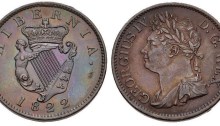
Introduction The short reign George IV was of huge numismatic importance to Ireland. George III’s Act of Union in 1801 had abolished the Irish Parliament in Dublin and extended direct rule over Ireland by the English Parliament in London. George IV went further :- The Assimilation of Currencies Act, 1825 provided for the abolition of the separate…
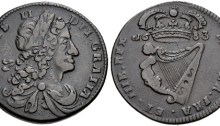
Introduction On 23rd October 1680, letters patent were granted to Sir Thomas Armstrong and Colonel George Legge) to manufacture copper halfpennies for use in Ireland for a period of 21 years. They were to be dated 1680, 1681, 1682, 1683, 1684 and 1685 but, since Charles II died in 1684, no coins dated 1685 have…
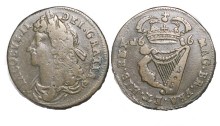
Although Armstrong & Legge’s patent to produce copper halfpennies for use in Ireland was confirmed by James II, these coins were actually minted by Sir John Knox, the Lord Mayor of Dublin. On the 17th June 1685, they transferred this patent by deed of appointment to Sir John Knox for the remainder of the time…

In 1694 Queen Mary II died of smallpox and William continued to rule alone. In 1694 William set up the Bank of England in order to fund his war against Louis XIV The revolution of 1688, which brought William and Mary to the throne, gave England a measure of political stability and commerce flourished, but the…

In 1660, the crown prince (later James II) married Anne Hyde, daughter of Charles II’s chief minister and they had two surviving children, Mary and Anne (both raised as Protestants) but in 1669, Prince James converted to Catholicism and took a stand against a number of anti-Catholic moves, including the Test Act of 1673. This…

Introduction In 1636, directions were given to Lord Maltravers and Sir Francis Crane “to make a new sort of farthing token which should have a little brass in the middle of the copper to distinguish the true farthings from forgeries.” The harp on the reverse was replaced by a rose, and hence these pieces are…
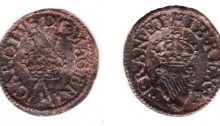
Introduction In 1634 another farthing patent was issued, to Henry Howard, (Lord Maltravers) and Sir Francis Crane, their issues being known as Maltravers Farthings. Howard had married Lady Elizabeth Stuart, daughter of Esme Stuart, 3rd Duke of Lennox in 1626, so this patent was ‘passed on’ to yet another member of the royal family. The other…
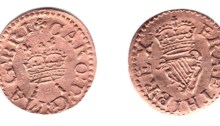
Introduction During the reign of Charles I, (1625–1649), farthings continued to be produced under the king’s licence. Towards the end of the reign of James I, in 1623 Ludovic, Duke of Lennox acquired the additional title of the Duke of Richmond, but died a few months later without an heir. The farthing patent passed to…
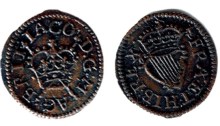
Introduction Strictly speaking, the Harington ‘patent’ Farthings are not part of the Irish coinage of James I but, since many turn up in Ireland (either as genuine finds, or as imports by collectors or dealers), they cause a lot of confusion due to their having a harp on the reverse. Also, this patent was carried…
 The Old Currency Exchange is a specialist dealer and valuer of Irish & GB coins, tokens and banknotes