 Date: 1664
The habit of coffee drinking first became popular in Europe about the middle of the 17th century. Soon, special rooms were established for the consumption of the new beverage. Debate surrounds the date of the first coffee house in England, the Angel in Oxford is considered first by some historians, set up about 1650, while others favour London as the first, with Oxford following shortly afterwards.
- Some time between 1652 and 1654 London’s first coffee house was opened by Pasqua Rosee, the Turkish servant of an English merchant who traded with The Levant (an old name, first used in English in 1497, referring to “the Ottoman East,” or “Mediterranean lands east of Italy).
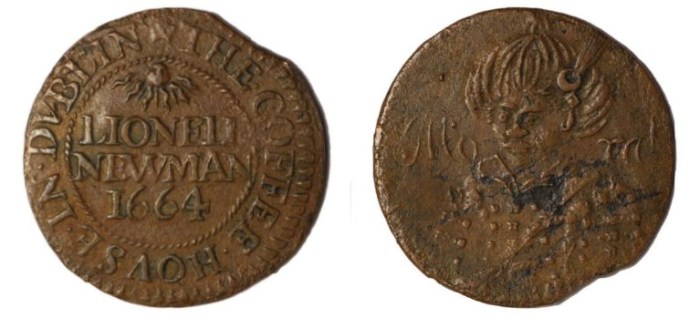
The earliest known reference to a coffee house in Dublin comes from a token for the business issued by its owner, Lionell Newman.
- Newman opened his premises sometime around 1664
- The origins of his beverage are acknowledged with the face of Sultan Morat of Turkey (reverse).
- The main concentration of Dublin coffee houses stretched from Parliament House in College Green to the Tholsel and Four Courts at Christchurch and northwards to the river at the Custom House (then located at what we now known as Capel Street Bridge).
- Curiously, Lionell Newman was the only coffee house owner to issue trade tokens during the 17th century in Dublin, despite the rising popularity of the beverage
- Coffee-houses were public spaces, associated with trade and commerce, politics, journalism and the law, and located in the busiest part of town with a conspicuous public profile.
- Llyod’s of London, the famous insurance marketplace, was founded in a London coffee house close to the river due to ‘early knowledge’ gained from sailors disembarking.
Lionell Newman’s Trade Token
Description:
Dublin, Lionell Newman, penny, 1664
- Williamson 371; Norweb 6257
- Very rare
Obverse:
- Centre design:
- “LIONELL NEWMAN” with stylised sun above and “1664” below, within a beaded circle
- Outer legend:
- “THE . COFFEE . HOVSE . IN . DVBLIN”
Reverse:
- Bust of a Turk, dividing the horizontal legend “Mo” “rat” in stylised italic text
- Morat is thought to be the Sultan Murad IV (1623-40)
Additional Information:
In 1597, an older custom house at Wood Quay within the city walls at Winetavern Street was destroyed in the Dublin gunpowder explosion. This location, known as ‘the Crane of Dublin’, was said to have been in use since the mid-thirteenth century.
A later Customs House building was developed by James I eastward of the city walls near Essex Gate on reclaimed land around 1620 bordering Crampton Court and creating Crane Lane as a means of access to Dame Street. To facilitate the construction, James I took out a 90 year lease on a plot of land owned by one Jacob Newman – probably a relative of the Lionell Newman who opened a coffee shop in the 1660s. The lease stipulated that the land be used for ‘the convenient loading, landing, putting aboard or on shore merchandise as should at any time thereafter be exported or imported’ and this new Custom House became a focal point of commercial and leisure activity in Dublin, with visitors from Britain encouraged “to stay at one of the coffee-houses in Essex Street, by the Custom House” after their 10-12 hour journey across the Irish Sea from Holyhead to Ringsend.
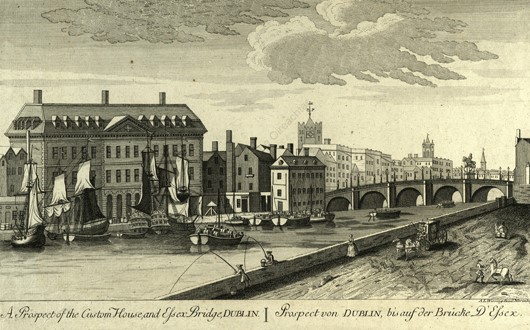
The Customs House & Essex Bridge, Dublin
The Customs House building was accessible via steps from Essex Bridge, and an archway leading to and from Essex Street to the south. Its principal entrances were in Temple Bar and Essex Street (exactly opposite the entrance to Crampton Court which was the most direct route to Dublin Castle). This area is likely the location of Newman’s coffee house.
- One of Newman’s competitors, Dick’s Coffee House was a significant Irish coffeehouse in the 17th and 18th century. Dick’s was one of Dublin’s most famous and long lasting coffeehouses, established by Richard Pue in the late 17th century, at some point before July 1698.
- Pue was a bookseller and owned one of Ireland’s earliest newspapers, Pue’s Occurences
- Dick’s was housed in Skinner’s Row (now Christchurch Place), on the drawing room floor of Carberry House, which had previously been the home of the Earl of Kildare.
- The customers of Dick’s were described in 1740: “Ye citizens, gentlemen, lawyers and squires, Who summer and winter surround our great fires, Ye quidnuncs! who frequently come into Pue’s, To live upon politicks, coffee, and news.
- Gilbert, John T. (1972). A History of the City of Dublin.
- The customers of Dick’s were described in 1740: “Ye citizens, gentlemen, lawyers and squires, Who summer and winter surround our great fires, Ye quidnuncs! who frequently come into Pue’s, To live upon politicks, coffee, and news.
Sadly Newman’s coffee house does not seem to have lasted into the golden age of coffee shops in Dublin – between 1680 and 1730s – possibly due to the fact that in 1676, when some London coffee houses became hotbeds for political protest, the city prosecutor decided to close them and cities throughout the three kingdoms soon followed.
- Although the ban was lifted in 1680, Newman’s does not seem to have survived.
- This new generation of Dublin coffee shops also sold tea and hot chocolate, as well as a range of alcoholic beverages.
Maxwell lists some of Dublin’s leading coffee houses and taverns, noting their clientele:
- Lucas’s Coffee House, on Cork Hill (the scene of many duels), frequented by fashionable young men
- The Phoenix, in Werburgh Street, where political dinners were held
- Dick’s Coffee House, in Skinner’s Row, much patronized by literary men (above a bookseller)
- The Eagle, in Eustace Street, where meetings of the Volunteers were held
- The Old Sot’s Hole, near Essex Bridge, famous for its beefsteaks and ale
- The Eagle Tavern, on Cork Hill, which was demolished at the same time as Lucas’s to make room for the new Royal Exchange. Perhaps Newman’s too fell foul of the Wide Streets Commission, which at that time was located in the new Custom House beside Essex Bridge ???
Although women could own and run coffee houses, their clientele was exclusively male and from a wide variety of the social classes, except the lower classes who restricted to taverns. They were often located upstairs in the grand saloons of the big houses of Dublin and had newspapers available for reading and discussion.
Further Reading:
Gilbert, John T. (1972). A History of the City of Dublin. Shannon: University Press. ISBN 071650605X.
Markman, Ellis (2004). The Coffee-House: a Cultural History. London: Weidenfeld & Nicolson. ISBN 0297843192.
Mac Con Iomaire, Máirtín (2 May 2012). “Coffee Culture in Dublin: A Brief History”. M/C Journal. 15 (2).


 The Old Currency Exchange is a specialist dealer and valuer of Irish & GB coins, tokens and banknotes