Further Reading:

Date: 1795
Description:
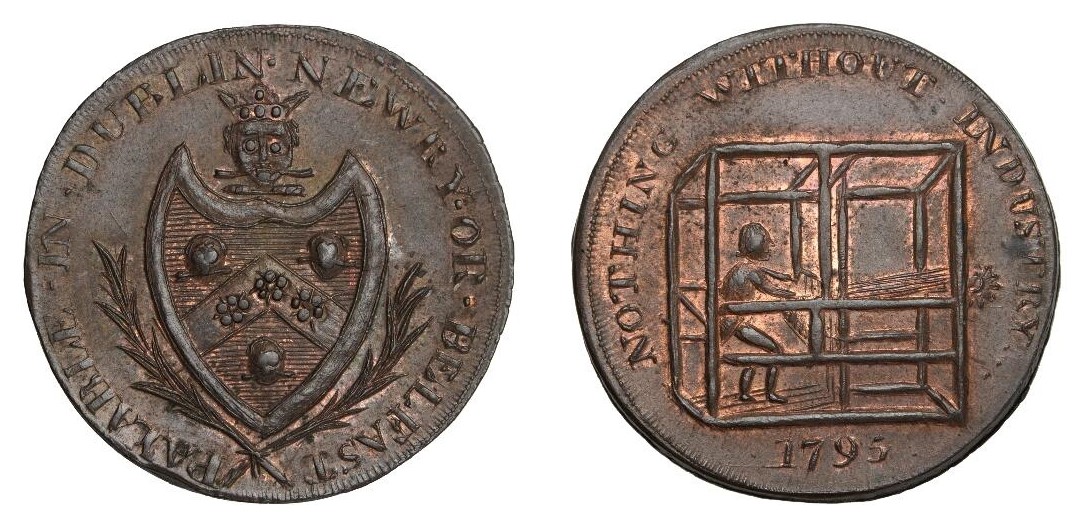
Dublin Weavers’ Company copper halfpenny token dated 1795
- Dublin Weavers’ Company copper halfpenny
- Diameter: 28.4mm
- Design engraved by Thomas Prattent (British engraver & coin dealer, active 1780–1810)
- Probably minted by William Lutwyche, of Birmingham
- D&H Dublin No: 16
- Listed in Dalton & Hamer as “RR – VERY RARE”
- Nice collectable condition, slightly off-centre
Obverse:
- The Coat of Arms of the Company of Weavers
- Legend surrounds: “PAYABLE IN DUBLIN NEWRY OR BELFAST”
Reverse:
- Weaver working in a box loom
- Legend: “NOTHING WITHOUT INDUSTRY” with date “1795” below
Edge:
- Plain
References:
- DH (Dublin 15a
Category:
- Irish Token Coinage
- Late 18th Century
- Dublin
- Dublin Company (Guild)
- Late 18th Century
Further Reading:
- Dalton, R. & Hamer, S.H., The Provincial Token Coinage of the 18th Century (1915)
- Morris, J.H. (2003) ‘The Battle of the Tokens, 1789-1799: The Hibernian Mining Company v. The Associated Mining Company’ Journal of the Mining Heritage Trust of Ireland
- Prattent, Thomas & Denton, M., The Virtuoso’s Companion & Coin Collecting Guide, etc, (8 vols) 1795-7
Additional Information:
The Irish Weavers Guild
In 1192, Prince John of King Henry II gave permission to the citizens of Dublin to form Guilds to counteract the tendency for the English settlers to become “more Irish than the Irish themselves”.
- The first to avail of this were the Merchants Guild which dates back to this time
- There were 25 guilds in medieval Dublin
- The Merchant’s Guild (first mentioned, 1451)
- The Tailor’s Guild (first mentioned, 1418)
- The Smith’s Guild (first mentioned, 1474)
- The Barbers & Surgeon’s Guild (first mentioned, 1446)
- The Baker’s Guild (first mentioned, 1478)
- The Butcher’s Guild (first mentioned, 1478)
- The Carpenters, Millers, Masons & Tyler’s Guild
- The Shoemaker’s Guild (first mentioned, 1426)
- The Saddlers, Upholders, Coach & Coach-harness maker’s Guild
- The Cooks & Vintner’s Guild
- The Tanners & Currier’s Guild
- The Tallow-chandler’s Guild
- The Glovers & Skinner’s Guild
- The Weaver’s Guild (first mentioned, 1446)
- O’Brien Coin Guide: Dublin Weaver’s Company Copper Halfpenny Token (1795)
- The Sheermen & Dyer’s Guild
- The Goldsmith’s Guild (first mentioned, 1637)
- This is the only one of Dublin’s medieval guilds to have survived to the present day
- It is now located within the walls of Dublin Castle (just inside the Ship Street entrance)
- Link to The Company of Goldsmiths of Dublin website
- The Cooper’s Guild (first mentioned, 1501)
- The Feltmaker’s Guild (first mentioned, 1668)
- The Cutlers, Painters, Paper Stainers & Stationer’s Guild
- The Bricklayers & Plasterer’s Guild (first mentioned, 1670)
- The Hosiers & Knitter’s Guild
- The Currier’s Guild
- The Brewers & Maltster’s Guild
- The Joiners, Coylers & Wainscotter’s Guild
- The Apothecaries Guild
- O’Brien Coin Guide: The Trade Token of Henry Bollardt, Apothecary (Dublin, 1654)
The first charter of the Weavers Guild, dedicated to the Blessed Virgin Mary, was commissioned on the 28th September in 1446 and consisted of a Master, two Wardens and a Brethren. The Guild’s colours were orange and blue and it possessed its own coat of arms and royal seal.
- The Guild was held responsible for the art of weaving in the city and its suburbs.
- In addition to this, it also held the authority to sue and be sued, could establish a charity and hold lands up to the value of £40.
- The Guild could examine offenses by weavers, their servants and apprentices and also had the right to imprison those who offended the guild. As the Guild was entitled to put forward two of its members to sit on the Dublin City Assembly – the governing body of the city – it began to build great political standing and power amongst its peers.
To become an apprentice for the guild, one had to appear before the Master and Wardens and be examined to ensure they were of good condition, conversation and English nationality. They were then required to complete a 7-year apprenticeship, in which time they needed to satisfy their Master and Warden, before being given the freedom of the Guild.
- There were many large religious and prestigious events on the Guild’s calendar throughout the year, the first being its inclusion in the Corpus Christi Annual Pageant, in which each guild was represented by certain biblical characters.
- Every third year, they were summoned by the Lord Mayor to the Rising of Franchises, a procession which was conducted to establish the property boundaries of the citizens of Dublin. In time this event became an opportunity for the Guilds to showcase their various trades.
- Each of the 25 Guilds marched behind a horse drawn vehicle with floats and displays showcasing their fayre.
- The members of the Weavers Guild were said to have worn wigs made of wool and were noted as throwing scraps of cloth to the crowds.
- The Riding of the Guild became an expensive occasion as the Brethren of the Guild needed to pay money for contribution as well as materials for costumes and food for the horses.
The Huguenot Refugees
At some point in the 17th century, a group of French Huguenot Weavers arrived in Dublin and settled within the Liberties area. Many of them were highly-skilled Silk Weavers and their settlement within the Weavers’ community contributed greatly to the introduction of the silk and poplin industry in Ireland.
- On of them, David Digges Le Touche, funded the rebuilding of the Weavers Hall in the Lower Coombe, thought to be rebuilt in 1745.
- The address was 14, The Coombe
- The main room of the new hall was thought to be fifty-six feet long by twenty-one feet wide
- It was adorned by many masterpieces of the weaving craft including a tapestry of King George II that was woven under the direction of John van Beaver and possibly woven in the workshop of Robert Baillie from .
- In 1750, a statue of George II was erected on the front of their hall as a mark of their loyalty.

Statue of George II, above the door of the Dublin Weaver’s Guild and tapestry of George II woven under the direction of John van Beaver and possibly woven in the workshop of Robert Baillie (1732–35)
Around this time the Guild became very protective of their work and their standards and began to impose fines for any work which was deemed inferior. The Guild also stated that certain cloths of quality should have a lead seal attached.
- The 3-inch seal consisted of the name of the maker, the alnage seal, the round lead seal with the crest of the corporation and the words Cor. Weavers on one side and a harp and a crown and C.& C. Dublin on the other.
- Anyone who was caught brandishing a false seal was imprisoned.
The end of the 17th and 18th century was a time of great wealth in the city of Dublin which was considered the second city of the Empire. The middle class busied themselves by buying land and trying to outdo one another in shows of great grandeur and wealth.
- The woollen, silk and poplin industries flourished during this time as ladies and gentleman alike paid lavishly for home accessories and fine cloths for clothes.
- However, the good days were short-lived as the jealously of the English manufactures caused the introduction of laws which prohibited the export of all types of woollen cloth being made in Ireland during that time.
- Many accounts of the hardship this caused to the weavers have been recorded with numerous accounts from the 1730’s & 1740’s of Weavers attacking the homes of Merchants housing stocks of imported cloth.
- Many a petition for relief from the Weavers Guild to the parliament was drawn to try and salvage the livelihoods of the Weavers but these all fell upon deaf ears.
- In 1753, the Silk Weavers were put under more strain by the importation of foreign silks.
- In 1767 an almshouse was built for impoverished weavers in the great Weavers Hall which was funded by lotteries to try and help those ruined by the restrictions on their trade.
In 1764, the Society of Dublin came to the aid of the Weavers and their workers by establishing a Silk Warehouse in Parliament Street and later on in 1773, a Woollen Warehouse to promote the sale of home produced goods. Whilst these measures helped in some degree, the effects of the Anglo-French War (1778–1783) were beginning to set in and raw materials were difficult to source but it was the result of the French Revolution (1787-1799) that saw the final straw for many of the Weavers and sent them down into the streets of the city to live amongst the poor and squalid.
The Guild system was in decline from the beginning of the 18th century until 1840 when it was abolished entirely. Many things contributed to its abomination but perhaps the greatest being the collapse in the fraternal spirit that had once kept the organisation together. The once heartbeat of the Guild was replaced by a hunger for better pay and working conditions which eventually led to the downfall of the Guild’s Masters.
- Furthermore, the exclusion of any Catholic or Irish Merchants to the Guild meant that most tradesmen carried on illegally but still began to grow stronger.
- As time went by, the Guild which still continued to hold meetings amongst its members became more about political gain then about the craft of weaving itself.
In 1835, a special report on the City of Dublin commissioned by the Town Corporation Council decreed that in fact the Guild of Tailors did not include a majority of the Tailors trading the in city so therefore did not hold any rightful purpose over the trade. It was concluded that this report was also a probable window into the reality of other ruling Guilds.
- As a result of the report, an Act was passed for the reform of the municipal system and the act of The Municipal Corporations (Ireland) Act of 1840, marked the end of the Guild system.
A couple of years later, the once flourishing Guild system entirely vanished from the Irish landscape and was replaced by a more democratic system of election to government. Only the guild known as the Company of Goldsmiths of Dublin survived and still to this day protects the high standard of its craft from where it resides in the Guild Hall in Dublin Castle.
- The Weavers’ Hall was later demolished in 1965
- The only original still standing Guild Hall from that era is the Tailors’ Hall in Back Lane.
- The tapestry of George II woven by John van Beaver, which hung in the Weavers’ Hall, now hangs in the Metropolitan Museum of New York.
The tradition of silk and poplin weaving in the Liberties continued through the nineteenth century and in some cases into the twentieth century, with firms such as Frys, Pims, Elliots, Atkinsons and Mitchells. Elliots, the last factory in production, closed in c. 1965.


 The Old Currency Exchange is a specialist dealer and valuer of Irish & GB coins, tokens and banknotes