How to identify the Irish chickless penny variety ireland coins coinage

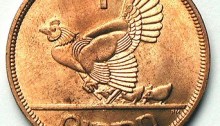
O’Brien Coin Guide: How to identify the Irish “Chickless” Penny Variety

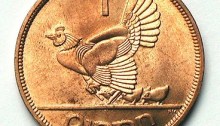
The ‘chickless’ variety is probably a die flaw caused by normal ‘wear and tear’ on the dies during the minting process.  This variety has become very popular with collectors over the past decade and some claim to have evidence of “progressive wear across several examples of 1968 pennies” leading to a chickless coin. The most…

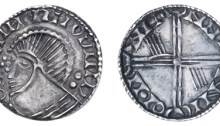
Phase III, Penny, bust left, two pellets in front of face and behind head, rev. long voided cross with hand in two quarters, blundered legends

O’Brien Coin Guide: Introduction to the Hiberno-Norse Coinages of the Late 10th & Early 11th C

The first locally produced Irish coinage was the so-called Hiberno-Norse coinage which was first minted in Dublin in about 995-7 AD under the authority of Sihtric III (aka Sihtric Silkenbeard), the Norse King of Dublin.  There is no evidence for the native Irish producing coins before this, so it is likely that their economy was not coin-based.  The…

1928-68 Irish Penny (reverse design)

O’Brien Coin Guide: Irish Pre-Decimal Penny

The penny (1d) (Irish: pingin) coin was the third smallest denomination of the pre-decimal Irish pound.  There were 12 to a shilling, 24 to a florin and 240 to a pound.  To express an amount, penny was abbreviated to “d”, e.g. shortened from dwt, or pennyweight. The penny is one of the longest circulating coin denominations in Europe –…

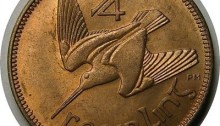
1928-66 Irish Farthing (reverse design)

O’Brien Coin Guide: Irish Pre-Decimal Farthing

Ireland is one of only four nations to issue farthing coins in the 20th century.  The other three countries to circulate farthings were the UK (1900-1956), South Africa (1923-60), and Jamaica (1900-63). British farthings ceased to be legal currency in 1960 The farthings of South Africa, Jamaica and Ireland ceased to be legal currency in 1961, 1969…

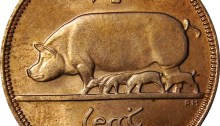
Controversy follows 1927 Irish coin design competition results

In 1922 Ireland won its independence from Britain after a two-year War of Independence and protracted negotiations in London.  The team, authorized to negotiate on behalf of Dáil Eireann, signed a treaty and, after ratification by ‘simple majority’ in the Dáil and by a referendum vote by the Irish people, the Irish Free State was…

O’Brien Rare Coin Review: Why is the 1992 Irish 10p coin so valuable?

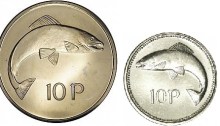
Introduction The Irish government began minting the original 10p coin two years prior to Decimal Day, 15 February 1971, hence the first 10p coins were dated 1969 and 1971 – when they were first circulated.  These coins retained the exact design and dimensions (except denomination) of the old (pre-decimal) florin coin, first introduced to the…