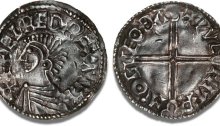
Aethelred II, Type 5 - Long Cross penny, Moneyer, Wulfmær of Castle Gotha

O’Brien Coin Guide: Anglo-Saxon Coins & Their Links To Ireland

It may come as a bit of a surprise to many that although Celtic coins have not (yet) been discovered in Ireland, there have been a lot of Roman and Anglo-Saxon coins found – especially the latter.  Conservative Irish historians have always said the Romans never got here but they rarely even mention the Anglo-Saxons…
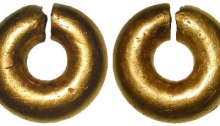
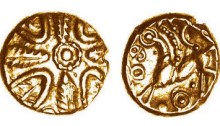
The Enigmatic Coins of the Celtic Tribes of Britain

Celtic coinage is the most intriguing and varied of all the British coins since no one knows specifically for whom, when or where they were produced.  To date, over 45,000 of ancient British and Gaulish coins have been discovered in Britain and all of these have been recorded at the Oxford Celtic Coin Index, but…

O’Brien Coin Guide: The Unofficial Irish Token Coinages of George III (1760-1820)

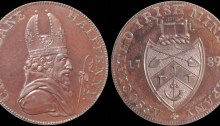
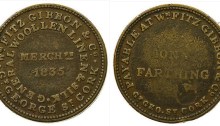
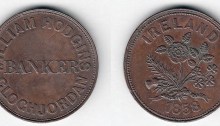
Introduction The late 18th century is a complicated time from the perspective of collecting tokens insofar as several dealers began to manufacture their own tokens for collectors, i.e. these did not circulate. They doubled and tripled their profits by deliberately producing mules, i.e. mis-matching obverse and reverse dies. They then increased their profits further by…

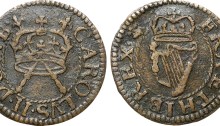
The Irish Armstrong farthing legend reads as follows :- CAROLVS II D G M B FRA ET HIB REX which translates and expands to :- Charles II by the grace of God, King of Great Britain, France and Ireland

O’Brien Coin Guide: Armstrong’s ‘Patent’ Irish Farthings (1660-61) for Charles II

Upon his restoration to the crown in 1660, King Charles II granted a patent to Sir Thomas Armstrong to ‘coin farthings’ for the next twenty years and all other (unofficial) farthings were to be prohibited.   In 1661, two royal proclamations were issued prohibiting the issuing and use of brass or copper tokens In 1662,…

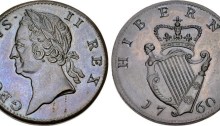
1760 George II (1727-1760), Copper Halfpenny, Type IV

O’Brien Coin Guide: The Irish ‘Regal Coinage’ of George II (1736-1760)

George Augustus was King of Great Britain & Ireland, Duke of Brunswick-Lüneburg (Hanover) and Prince-elector of the Holy Roman Empire from 11th June 1727 until his death on 25th October 1760. Both of George’s parents committed adultery In 1694 their marriage was dissolved on the pretext that Sophia had abandoned her husband She was confined to Ahlden House and…

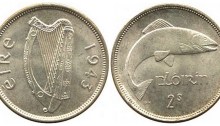
coins, numismatics, irish free state, eire, ireland, florin, two-shillings, The rare 1943 Ireland florin - approx. known examples exist.

O’Brien Rare Coin Review: Why is the 1943 Irish Florin so valuable?

Introduction The 1943 florin is the rarest ‘modern’ Irish coin to have actually circulated. The 1985 Irish 20p was not intended to circulate The 1992 Irish 10p was not intended to circulate Both of the coins listed above were minted for only testing purposes, i.e. to calibrate vending machines and they were supposed to have…