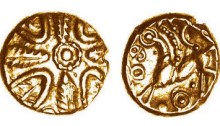
The Enigmatic Coins of the Celtic Tribes of Britain

Celtic coinage is the most intriguing and varied of all the British coins since no one knows specifically for whom, when or where they were produced.  To date, over 45,000 of ancient British and Gaulish coins have been discovered in Britain and all of these have been recorded at the Oxford Celtic Coin Index, but…
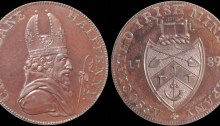
O’Brien Coin Guide: The Unofficial Irish Token Coinages of George III (1760-1820)

Introduction The late 18th century is a complicated time from the perspective of collecting tokens insofar as several dealers began to manufacture their own tokens for collectors, i.e. these did not circulate. They doubled and tripled their profits by deliberately producing mules, i.e. mis-matching obverse and reverse dies. They then increased their profits further by…

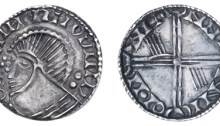
Phase III, Penny, bust left, two pellets in front of face and behind head, rev. long voided cross with hand in two quarters, blundered legends

O’Brien Coin Guide: Introduction to the Hiberno-Norse Coinages of the Late 10th & Early 11th C

The first locally produced Irish coinage was the so-called Hiberno-Norse coinage which was first minted in Dublin in about 995-7 AD under the authority of Sihtric III (aka Sihtric Silkenbeard), the Norse King of Dublin.  There is no evidence for the native Irish producing coins before this, so it is likely that their economy was not coin-based.  The…

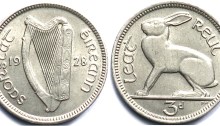
Ireland 1928 threepence coin ireland saorstat eireann eire percy metcalfe

O’Brien Coin Guide: Irish Pre-Decimal Threepence

The threepence (3d) (Irish: leath reul) coin was an Irish pre-decimal coin and a great favourite of golfers who often used it as a green marker.  There were 4 threepences to a shilling and 80 to an old pound.  The Irish name (leath reul) literally meant “half a sixpence” and, unlike many other Irish coins of the time, it…

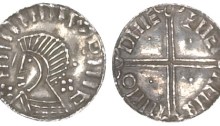
Hiberno-Manx silver penny, viking, Phase II imitation, isle of man, feremin,

O’Brien Coin Guide: The enigma of the Hiberno-Manx Coinages of the mid-11th Century

I am frequently asked the following questions and I openly admit to struggle to answer them adequately – the negative side of being a generalist dealer (constantly buying old attic finds and selling oddments from same), as opposed to being a specialist numismatic expert like so many of my much more knowledgeable customers. Who ordered…

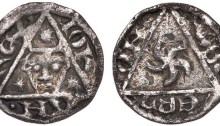
King John Irish farthing, Dublin mint

Collecting medieval Irish coins

One of the more difficult aspects of coin collecting is the language barrier one encounters when trying to decipher the legends (text around the edges) of coins. Very few of us speak Latin and truncated Latin still appears on British coins today. As we all know, British coins circulated alongside Irish coins in this country…