The new Central Bank of Ireland building on Dublin North Quays

Exciting news for Irish Numismatic historians as the Central Bank of Ireland opens its archives for public research

The Central Bank of Ireland has opened its archives to the public for the first time and we hope that many unanswered questions of Irish numismatic interest can, at last, be answered. These archives include a range of materials created and acquired by the bank – such as objects, documents and ledgers dating from 1786…

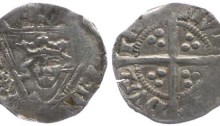
Ireland, Henry III silver penny (18mm, 1.37 g, 3h). Class Ia. Dublin mint, moneyer: Ricard, struck c. 1251-1254

Book Review: Henry III, Dublin Mint (Voided Long Cross 1251-54)

I don’t usually review books on Irish coinage but this one is an exception. Gerry Slevin, a native of Dublin, has just published the best book on Irish hammered coinage to date. It is filled with essential information, great photographs and a comprehensive set of legend and die variations. Gerry has previously published books on…

Viking Silver Trade Ingot, 10th-11th century AD - A rectangular-section ingot of silver with irregular ends.

Irish Coin Daily: Viking Silver Trade Ingot (Hammered)

Date: c. 950 – 1050 AD Description: A ‘hammered’ Viking Silver Trade Ingot, 10th-11th century AD – a rectangular-section ingot of silver with irregular ends. This ingot has been ‘worked’ into its current shape / dimensions via hammering on an anvil, i.e. flattened, elongated profile. Weight: 11 grams Length: 70mm (approx. 2.75 inches) Country: Ireland Category:…

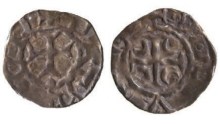
John De Courcy, Lord of Ulster (1177-1205), Farthing, anonymous issue, Downpatrick Mint, Processional cross within beaded circle, +PATRICII legend, rev short cross potent with crescents in angles, within beaded circle, +DE DVNO legend, 0.36g (Withers Downpatrick 1; D.F. 47; S.6225). Toned, a pleasing very fine for issue and extremely rare

Irish Coin Daily: Silver Farthing of John de Courcy, Lord of Ulster, (Second ‘Anonymous’ Coinage)

Date: c. 1195  Description: John De Courcy, Lord of Ulster (1177-1205), Farthing, anonymous issue, Downpatrick Mint, 0.36g (Withers Downpatrick 1; D.F. 47; S.6225). Very Fine (VF) Toned, nicely preserved specimen for type Extremely Rare Obverse: Processional cross within beaded circle +PATRICII Reverse: Short cross potent with crescents in angles, within beaded circle +DE DVNO Country:…

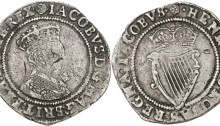
IRELAND. JAMES I, 1603-1626. 2nd Coinage. Shilling, nd (1604-07). Mm rose. Obv: Crowned bust right. Rev: Crowned harp. 4.35 grams. S.6515 / DF 261. Fine to Very Fine.

Irish Coin Daily: James I, Silver Shilling, Third Bust / Second Irish Coinage – m.m. Rose (1605/6)

Date: c. 1605-06 Description: James I, 2nd Coinage. Irish Shilling, no date, but the mint mark: Rose denotes the year 1605-06. Struck at the Tower Mint, London. Weight: 4.35 grams. . Fine to Very Fine  (F / VF) References: S.6515 / DF 261 Obverse: Crowned (third) bust of James I, facing right. The third bust can be…

Duke of Ormonde’s gold coinage of 1646-7, Pistole, Dublin, undated, stamped 4dwt 7grs both sides

Difficulties in grading old coins

For many collectors the topic of coin grading is a vexing one – it often seems so subjective and inconsistent. Of course, the most common and obvious targets for their ire are the dealers and auctioneers who, by way of describing their wares, are forced to commit their opinions of grade to paper. No ‘absolute’…

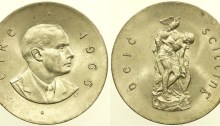
Ireland 1966 ten shilling commemorative coin - inscribed "Éirí Amach na Cásca 1916", which translates as "1916 Easter Rising" on the edge.

O’Brien Coin Guide: Irish Pre-Decimal Ten Shillings

Introduction In 1926, the Minister for Finance set up a special committee of persons with artistic knowledge to advise on the designs and he chose Senator W. B. Yeats to chair it. At the first meeting of the committee, on the 17th June 1926, Joseph Brennan (at that time Secretary to the Department of Finance and later Chairman…

Edward III Halfpenny, Dublin mint

O’Brien Rare Coin Review: The Irish Coinage of Edward III (1339-40)

Introduction After Edward III, there was a gap in Irish coin production of over 120 years. What caused this? Was it an economic or political decision, or a combination of several different causal factors? Did the causal factors occur before and/or during the reign of Edward III ??? No coins would be minted in Ireland for…