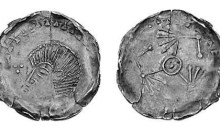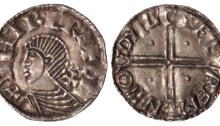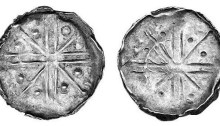
Hiberno-Norse Silver Penny, Phase V mule, crude bust left, trefoil of pellets to left (S.6139) + three birds around central pellet (S.6169). The Old Currency Exchange, Dublin, Ireland.

Irish Coin Daily: Hiberno-Norse Phase V Silver Penny Mule (crude bust left, trefoil of pellets to left (S.6139) + three birds around central pellet (S.6169)

Date: c. 1080 – 1085 Description: Hiberno-Norse coinage, silver penny mule, Phase V coinage. Diameter: 17mm Weight: c. 0.7g. Good very fine (gVF), with some surface cracks and flat areas Obverse: Crude bust left, trefoil of pellets to left (S.6139) Blundered and illegible legend around Reverse: Three birds around central pellet (S.6169) Blundered and illegible legend…

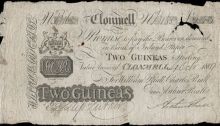
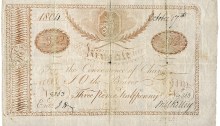
Clonmell Bank, Two Guineas (Two Pounds, Five Shillings and Sixpence), 4 October 1809, B 168, payable in Bank of Ireland Paper, for William Riall, Charles Riall and Arthur Riall, signature of Arthur Riall. Endorsements on back, pinholes, small holes, tear and missing small piece at top right, otherwise very good. The Old Currency Exchange, Dublin, Ireland.

Irish Banknote Guide: Two Guineas The Clonmell Bank (Riall’s Bank)

The Clonmell Bank Riall’s Bank in Clonmel was one of the best run banks of its time. Founded in 1715 as The Clonmell Bank by Phineas Riall and managed by him until 1724, the bank was known as Bagwell & Co between 1724 and 1754. In 1754, William Riall became senior partner and he traded…

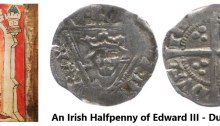
An Irish Halfpenny of Edward III (Dublin Mint)

O’Brien Coin Guide: The Unknown Irish Penny of Edward III

Introduction: In numismatic terms ‘unknown’ means that none have been found – therefore asking the question “did they ever exist?” There are many instances where we know of a king commanding that coinage be produced but none have been found. Ironically, when ‘one’ is found, we begin to ask another set of questions: Is it…

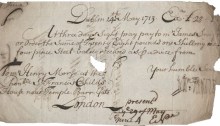
1713 Sight Note (£28, 1s & 4d) James Swift. The Old Currency Exchange, Dublin, Ireland.

Irish Banknote Guide: James Swift & Co (Dublin) 1721-1746

Introduction: James Swift registered his bank in Dublin in 1721 but he was operating in Dublin beforehand, probably as a Goldsmith notory or banker of some description – as can be seen by this ‘sight note’ from Sir Francis Child (a London Goldsmith and banker). Sight note, 14 May 1713, ‘At three days sight pay…

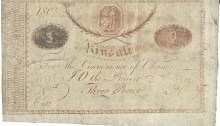
180_ Kinsale (Corporation), Threepence (for the convenience of change). The Old Currency Exchange, Dublin, Ireland.

Irish Banknote Guide: 180(4) Kinsale Corporation (3d note)

Date: c.1804 Few people had silver or gold coins, and those who did, hoarded them and did not use them unless they really had to. Most of the smaller change in circulation was unofficial, illegal tokens. In short, there was a local currency crisis. The solution was small notes (an IOU) like the one below…

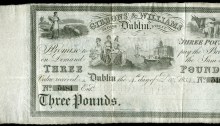
1834 Dublin, Gibbons & Williams Bank, Three Pounds, 4 December 1834, no. 5484, unissued, with counterfoil (PB 159). The Old Currency Exchange, Dublin, Ireland.

O’Brien Banknote Guide: Gibbons & Williams Bank, Dublin (1833-1835)

Introduction: The short-lived Gibbons & Williams Bank issued some of the most attractive banknotes of the period – being printed on both sides and featuring many beautiful vignettes of Dublin and agricultural themes. As such, they are highly sought after by collectors. Their one pound, thirty shilling and three pound notes were payable in Dublin…

James I Silver Irish Shilling, First coinage, First bust, Mintmark Bell, 4.27g 28.4mm, S.6512. The Old Currency Exchange, Dublin, Ireland.

Irish Coin Daily: James I, Silver Shilling, First Bust / First Irish Coinage – m.m. Bell (1603-4)

Date: 1603-04 Description: James I Silver Shilling, First coinage, struck at the Tower Mint, London. No date but the mint mark: Bell denotes the year 1603-04. This issue of Irish shillings were of good silver but, being only three-quarters of the weight of an English shilling, they were accepted as legal tender in England and…

Hiberno-Norse Phase II Silver Penny, Sihtric of Dublin (Moneyer FAEREMIN) Draped bust left, cross pattée behind neck with two pellets above, 1.37g. The Old Currency Exchange, Dublin, Ireland.

Irish Coin Daily: Hiberno-Norse Phase II Silver Penny, Sihtric of Dublin (Moneyer: FAEREMIN)

Date: c. 1020-1035 Hiberno-Norse Phase II Long Cross Penny, Sihtric of Dublin, with Dublin mint signature of Færemin (Moneyer of Dublin) – the most common moneyer of this phase. Weight: 1.37 g Diameter: 18mm Near Extremely Fine (nEF) A bold and attractive example of this variety References: SCBI Hiberno-Norse 64-66 var. (no pellets behind bust…

1833 £10 Gibbons & Williams, Dublin, S/N 99, dated 1st July 1833 and signed by Hutchins Thomas Williams. The Old Currency Exchange, Dublin, Ireland.

Irish Banknote Guide: Ten Pounds (Gibbons & Williams’ Bank) 1833

Gibbons & Williams Bank: Gibbons & Williams was one of the last private banks to be founded in Ireland. Founded in 1833, it spectacularly collapsed in 1835 when the senior partner, Hutchins Thomas Williams, was found to have been embezzling client funds. James Gibbons had parted company with him in 1834 and wasn’t involved in…