1826 Hibernian Bank Twenty Pounds Token, proof, undated. The Old Currency Exchange, Dublin, Ireland.

Irish Banknote Guide: c. 1826 Hibernian Bank – Twenty Pounds Token, Type 1

Date: c. 1826 Description: 1827 Hibernian Bank Twenty Pounds Token, Type 1 (no ‘promissory’ text). No date No serial number This is the largest known denomination for these tokens An extremely rare early paper note Obverse: Design comprises two vignettes, one to the left of Hibernia seated with a harp and the other (on the…
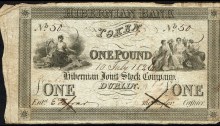
1826 Hibernian Bank One Pound Token, Type 1, dated 10th July 1826 . The Old Currency Exchange, Dublin, Ireland.

Irish Banknote Guide: 1826 Hibernian Bank – One Pound Token, Type 1

Date: 1826 Description: 1827 Hibernian Bank One Pound Token, Type 1 (no ‘promissory’ text). Manually dated ’10 July 1826′ and numbered ’50’. Countersigned front and back Cancelled with ink ‘x’ over clerk and cashier’s signatures A rare early paper note Obverse: Design comprises two vignettes, one to the left of Hibernia seated with a harp…

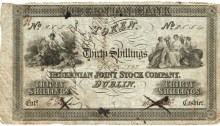
1827 Hibernian Bank Thirty Shillings Token, 1 February 1827. No. 3554. Countersigned front and back, cancelled with ink 'x' over clerk and cashier's signatures, rare. The Old Currency Exchange, Dublin, Ireland.

Irish Banknote Guide: 1827 Hibernian Bank – Thirty Shillings Token, Type 1

Date: 1827 Description: 1827 Hibernian Bank Thirty Shillings Token, Type 1 (no ‘promissory’ text). Manually dated ‘1 February 1827’ and numbered ‘3554’. Countersigned front and back Cancelled with ink ‘x’ over clerk and cashier’s signatures A rare early paper note Obverse: Design comprises two vignettes, one to the left of Hibernia seated with a harp…

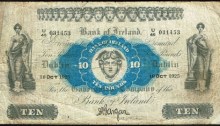
1925 Bank of Ireland (Seventeenth Issue) Ten Pounds, Type 1b, dated 10 Oct 1925, signed by Gargan, Chief Cashier. The Old Currency Exchange, Dublin, Ireland.

Early Irish Banknotes: 1925 Bank of Ireland (Seventeenth Issue) Ten Pound Note, Type 1b

Date: 1925 Description: A Bank of Ireland (Seventeenth Issue), Ten Pound Note, Type 1b (Larger fractional prefix), Signature: Joseph A. Gargan, Chief Cashier. Date: 10-OCT-1925 Issued on 10th October 1925 Serial Number: U/46 031453 Size: 200mm x 115mm Country: Ireland Category: Early Irish Banknotes Bank of Ireland Seventeenth Issue  Ten Pounds Type 1b   Further…

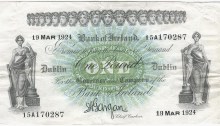
1924 Bank of Ireland, One Pound Note (Seventeenth Issue), Type 1b. Serial Number: 15A170287 (in black). Signed by: Joseph A. Gargan, Chief Cashier. The Old Currency Exchange, Dublin, Ireland.

Early Irish Banknotes: 1924 Bank of Ireland (Seventeenth Issue, Type 1c) One Pound note

Date: 1924 Description: A Bank of Ireland Pound note (Seventeenth Issue), Type 1b Issued on 19th March 1924 Serial Number: 15A170287 (in black) Signed by: Joseph A. Gargan, Chief Cashier Obverse: The £1 note of this 17th issue of the Bank of Ireland series features A blue-green underprint with a green oval design One panel…

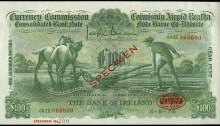
£100 ploughman, Bank of Ireland, One Hundred Pounds, specimen 1978 obverse. The Old Currency Exchange, Dublin, Ireland.

O’Brien Banknote Price Guide 2016: Ploughman £20, £50 and £100 notes (Specimens, Colour Trials & Proofs)

Withdrawal from Circulation: According to Central Bank of Ireland records, all £20, £50 and £100 ‘ploughman’ notes were successfully withdrawn from circulation, i.e. there are no ‘circulating’ examples left for collectors to collect. That said, the remaining £1, £5 and £10 ‘ploughman’ notes aren’t exactly common nowadays either – as per table below: Estimated Number…

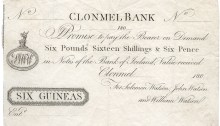
Promissory Note: Six Guineas (or, Six Pounds, Sixteen Shillings & Sixpence) - Watson's Bank, Clonmel, Co Tipperary. The Old Currency Exchange, Dublin, Ireland.

Irish Banknote Guide: Six Guineas The Clonmel Bank (Watson’s Bank), c. 1800

The Clonmel Bank Watson’s Bank was located on Johnston Street, in Clonmel and was founded by Solomon Watson in 1800, along with two of his brothers (John Watson and William Watson) as partners. The Watson’s were a well known Quaker family in Clonmel and their bank went through 3 partnership changes before ceasing operation in…

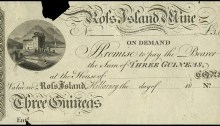
18__ Killarney, Ross Island Mine, Three Guineas, 18–, uniface proof on paper. The Old Currency Exchange, Dublin, Ireland.

O’Brien Banknote Guide: Ross Island Mine (Killarney) 1804-c.1819

Introduction: The history of mining at Ross Island in Killarney, Co Kerry, can be traced back to the Bronze Age, where several ancient metal finds from Killarney point to a significant Early Bronze Age settlement in the area. The Bronze Age Workings: The Bronze Age work camp at Ross Island provides an insight into daily…

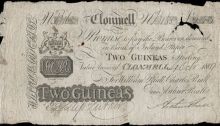
Clonmell Bank, Two Guineas (Two Pounds, Five Shillings and Sixpence), 4 October 1809, B 168, payable in Bank of Ireland Paper, for William Riall, Charles Riall and Arthur Riall, signature of Arthur Riall. Endorsements on back, pinholes, small holes, tear and missing small piece at top right, otherwise very good. The Old Currency Exchange, Dublin, Ireland.

Irish Banknote Guide: Two Guineas The Clonmell Bank (Riall’s Bank)

The Clonmell Bank Riall’s Bank in Clonmel was one of the best run banks of its time. Founded in 1715 as The Clonmell Bank by Phineas Riall and managed by him until 1724, the bank was known as Bagwell & Co between 1724 and 1754. In 1754, William Riall became senior partner and he traded…

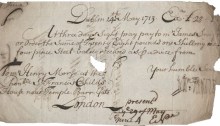
1713 Sight Note (£28, 1s & 4d) James Swift. The Old Currency Exchange, Dublin, Ireland.

Irish Banknote Guide: James Swift & Co (Dublin) 1721-1746

Introduction: James Swift registered his bank in Dublin in 1721 but he was operating in Dublin beforehand, probably as a Goldsmith notory or banker of some description – as can be seen by this ‘sight note’ from Sir Francis Child (a London Goldsmith and banker). Sight note, 14 May 1713, ‘At three days sight pay…