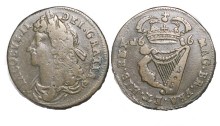
James II, King of England, Scotland & Ireland

Monetary Crisis (1689), as James II Fixes Exchange Rates for Foreign Coins in Ireland

Introduction When James II succeeded his father in 1685, he continued to issue copper halfpennies, albeit via a ‘patent’ like his father did before him. This maintained the flow of small change but the same ‘decades old’ problem persisted with the large proportion of under-weight ‘clipped’ silver in circulation. This might have sufficed for transactions…

Portrait of King Charles II, by John Riley

Monetary Crisis (1660), as Charles II Fixes Exchange Rates for Foreign Coins in Ireland

Introduction Though fresh attempts were being made in the reign of Charles II to strengthen Britain’s currency, these efforts did not prevent the monetary crisis of the 1680s which saw a fast decline of England’s currency on the international exchange markets. The basic unit of account was the pound sterling defined as the equivalent of 240 pennies…

1929 £10 Consolidated Banks - Provincial Bank of Ireland (front) Unc

O’Brien Rare Banknote Review: Ploughman Notes (Provincial Bank of Ireland)

Introduction The Provincial Bank of Ireland was established in 1825, pioneered branch banking in Ireland. The terms, rights and privileges of the Bank of Ireland allowed it to effectively strangle the development of banking in Ireland until the Irish Banking Crisis that followed the post-Napoleonic War Depression. The Bank of Ireland effectively held a monopoly…

William & Mary, halfpenny, 1692, (S6597) Edge flaw, good very fine and scarce

O’Brien Coin Guide: Irish ‘Regal Halfpennies’ of William & Mary

In 1660, the crown prince (later James II) married Anne Hyde, daughter of Charles II’s chief minister and they had two surviving children, Mary and Anne (both raised as Protestants) but in 1669, Prince James converted to Catholicism and took a stand against a number of anti-Catholic moves, including the Test Act of 1673. This…