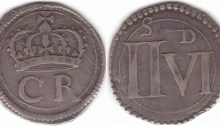
Ormonde Halfcrown. S.6545. Obv. Crown above C and R, a line circle around, and a somewhat crude blunt toothed outer border. Only cross of crown touches the inner line circle. Only the tail of the trailing R crosses the circle. A faint triangular pellet divides the C and R. The C has a near Roman top seraph, and no bottom seraph. Rev. Huge bold II, height 15.0mm, and shorter VI, height 11.3mm. All four corners of the IIVI cut across the inner line circle of 25.5mm diameter. Minute central pellet before V. An almost snakelike S with almost parallel Roman seraphs is centered above the II, and almost bisected by the line circle with bottom of top seraph of S just touching the outside of the inner circle. Well formed D, height 3.6mm, with a longer top seraph than bottom seraph, is above right side of V and closer to circle than to the V. Struck on an unusually round sterling plate flan, still showing part of original silver detail on obverse

O’Brien Coin Guide: The Ormonde Money of 1643-44

Introduction The 1642 ‘Lords Justices’ issues were followed in 1643 by a larger (fourth) emergency issue of better made, but still crude, silver coins. These are collectively known as ‘Ormonde Money’ since they were issued by the Lord Justice, the Earl of Ormonde (James Butler) some time between 1643-1644. Ormonde’s active career began in Ireland had begun…

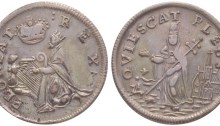
Duke of Ormonde’s gold coinage of 1646-7, Pistole, Dublin, undated, stamped 4dwt 7grs both sides

O’Brien Coin Guide: Introduction to the Emergency Coinages of the Great Rebellion of 1641-52

Introduction Many people think of the Great Rebellion as a two-sided fight – the Irish Catholics versus the Anglo-Irish Protestants … but it was a lot more complicated than that. There were at least five opposing parties during the rebellion, which have been described by Carlyle as follows :- the Catholics of the Pale demanding…

Cork, under Commonwealth authority, Farthing token, overstruck on a Double Tournois of Louis XIII

The Proliferation of Unofficial Irish ‘Farthing Tokens’ in the 17th Century

By the first half of the 17th C, the copper coinage in both Britain and Ireland was in complete disarray. Neither James I nor his son, Charles I, took much interest in providing small denominations and ‘farmed out’ the Royal prerogative of minting copper coins to ‘favourite’ courtiers as patentees – Lords Harington, Richmond, Lennox and Maltravers were the principal…

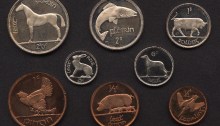
Ireland decimal 5p - large and small types

O’Brien Coin Guide: Irish Decimal Fivepence

The five pence (5p) coin (Irish: cúig phingin) was a sub-division of the Irish pound. It was introduced in Ireland on Decimal Day, 15th February 1971 and re-used the design on the shilling coin first produced for the Irish Free State in 1928.  Due to the similarity in size and weight, many of the old shillings…

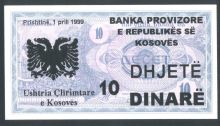
1999 Kosovo 10 dinare provisional issue (overprinted: UCK - Ushtria Clirimtare e Kosoves / Kosovo Liberation Army)

O’Brien Obsolete Currency Guide: Kosovo

Kosovo is a fertile region lying just to the northeast of Albania, in central former Yugoslavia. It is one of the earliest settlements by the Slavic people who later became the Serb nation – one of the reasons the hard-line nationalists in Serbia were so determined to include it as part of a Greater Serbia during…