Bosnia and Herzegovina 200 KM

O’Brien Currency Guide: Bosnia & Herzegovina (Convertible Mark)

Bosnia & Herzegovina Bosnia & Herzegovina declared sovereignty in October 1991 and independence from the former Yugoslavia on 3 March 1992 after a referendum boycotted by ethnic Serbs. The Bosnian Serbs – supported by neighboring Serbia and Montenegro – responded with armed resistance aimed at partitioning the republic along ethnic lines and joining Serb-held areas…

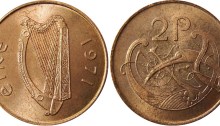
2002-2006 Ireland €2, Type I reverse

O’Brien Coin Guide: Irish €2 Coins

The two euro coin (€2) is the highest value euro coin and has been used since the introduction of the euro (in its cash form) in 2002.  The coin dates from 2002, when euro coins and notes were introduced in the 12 member eurozone and its related territories. The common side was designed by Luc…

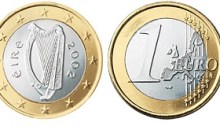
2002 Ireland €1, Type I reverse

O’Brien Coin Guide: Irish €1 Coins

The one euro coin (€1) is the new basic unit of currency for the Euro Zone – an area where a common currency (the Euro) is used.  This new economic area was implemented on 1st January 2002 when 12 national currencies of varying values were replaced with new coinage and banknotes.  The rates of exchange were…

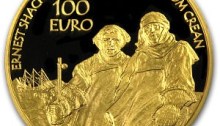
The 2008 €100 gold coin (polar explorers) - the largest (28mm diameter) and heaviest (half ounce) Irish gold coin to date.

O’Brien Coin Guide: Irish Commemorative Euro Coins

Most of the coins listed below were struck as ‘proofs’ – the exception being the first of the series, the €5 Special Olympics coin.  This was a cupro-nickel coin and is available as BU mini-presentation folder.  In addition to this, all other coins were struck in either Sterling silver or gold and are issued in…

Gold Lunula (2010:246) and Gold Discs (2010:247, 2010:248), Coggalbeg, Co. Roscommon. In 1947, for reasons still uncertain, Hubert Lannon handed these golden objects over to Mr Patrick Sheenan, a pharmacist in the town of Strokestown, Co. Roscommon. It appears that neither man fully appreciated the value of the artefacts and the National Museum of Ireland was not notified of their existence. Instead, Mr. Sheenan placed the artefacts in his family safe where they were to remain hidden for the next 50 years, only occasionally being brought out and shown to curious visitors.

Irish Metal Detectorists: Saints or Sinners?

At present, in Ireland, it is illegal to use a metal detector without a license and these licenses are very difficult to obtain + very restrictive in terms of where one can use a metal detector.  At face value, it is a common sense law designed to protect Ireland’s rich archaeological heritage from vandals, looters…