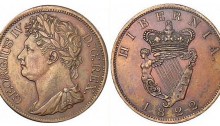
O’Brien Coin Price Guide 2016: The Irish Coinage of George IV
2016 Market Values Copper Penny Copper Halfpenny Copper Farthing <no image> No farthings were circulated.
2016 Market Values Copper Penny Copper Halfpenny Copper Farthing <no image> No farthings were circulated.
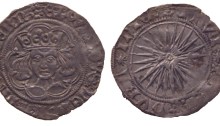
Introduction: Realising that having an Irish currency equal to English standard weights resulted in a massive drain of silver out of Ireland and, consequently, reducing the amount of coinage in circulation + causing a recession, Edward IV moved towards remedying this by announcing a new (lower intrinsic value) coinage for Ireland in 1467: double-groats (eight…
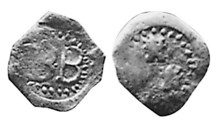
Bandon in 1641 The rural counties of Leinster, Munster and Ulster were sparsely populated by Protestant settlers that had been given land in recent plantations. In many places, the Catholic tenants that had previously worked the farms were still in the locality and subsisted as landless outlaws (woodkerne, or tories). When rebellion broke out, some…
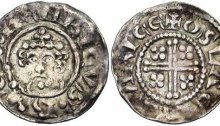
Background Henry’s Troubled Succession Henry was born in France at Le Mans on 5 March 1133 as the eldest child of Geoffrey the Fair, Count of Anjou, and the Empress Matilda, so titled because of her first marriage to Henry V, the Holy Roman Emperor. Henry’s mother was a very powerful woman: She was the…
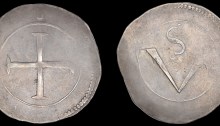
Introduction In the older literature, these coins are referred to as ‘Kilkenny Money’ but are now, more properly referred to as ‘Confederated Catholic Coinage’ or ‘Rebel Money.’ There are two opinions re who actually these enigmatic coins – one thinks they might have been minted by the Catholic Confederacy in Kilkenny from as early as September 1642…

Introduction In 1636, directions were given to Lord Maltravers and Sir Francis Crane “to make a new sort of farthing token which should have a little brass in the middle of the copper to distinguish the true farthings from forgeries.” The harp on the reverse was replaced by a rose, and hence these pieces are…
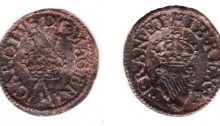
Introduction In 1634 another farthing patent was issued, to Henry Howard, (Lord Maltravers) and Sir Francis Crane, their issues being known as Maltravers Farthings. Howard had married Lady Elizabeth Stuart, daughter of Esme Stuart, 3rd Duke of Lennox in 1626, so this patent was ‘passed on’ to yet another member of the royal family. The other…
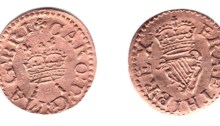
Introduction During the reign of Charles I, (1625–1649), farthings continued to be produced under the king’s licence. Towards the end of the reign of James I, in 1623 Ludovic, Duke of Lennox acquired the additional title of the Duke of Richmond, but died a few months later without an heir. The farthing patent passed to…
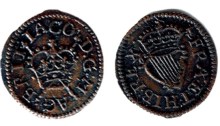
Introduction Strictly speaking, the Harington ‘patent’ Farthings are not part of the Irish coinage of James I but, since many turn up in Ireland (either as genuine finds, or as imports by collectors or dealers), they cause a lot of confusion due to their having a harp on the reverse. Also, this patent was carried…
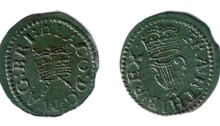
Introduction Strictly speaking, “most” of the Lennox ‘patent’ Farthings are not part of the Irish coinage of James I but, since many turn up in Ireland (either as genuine finds, or as imports by collectors or dealers), they cause a lot of confusion due to their having a harp on the reverse. Also, this patent…
 The Old Currency Exchange is a specialist dealer and valuer of Irish & GB coins, tokens and banknotes