The end of the eighteenth and beginning of the nineteenth centuries was a time of an acute shortage of ‘hard cash’ in Ireland and this was due to the fact that:
- Currency issued by the Royal Mint was limited to small copper coins; penny, twopence, threepence and fourpence
- The English Treasury had run out of silver and gold since the reign of Queen Anne
- They were relying upon the periodic capture of Spanish and French bullion by their navy
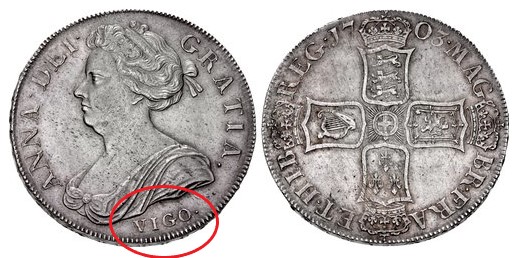
- They even marked some of their silver coins with the name of a treasure ship, the Vigo!
When Admiral Sir George Rooke, commander of the combined fleet, learned the 1702 treasure had arrived at Vigo Bay in Spain, he resolved to seize it. His force of fifty ships besieged the harbor, destroying the French fleet guarding the convoy, sinking most of the ships and capturing cargo worth £2 million pounds at the time. A special issue of gold and silver coins was struck from the captured plate and a number of medals honoured the great victory. Two million was a lot of money back then but it had well and truly ran out by the 1780s.
Things got a lot worse by the time George III came to the British & Irish throne in 1760. During the 40 years reign of George III. there were no silver coins struck for use in England, with the exception of the 1787 shilling and sixpence. The shilling dated 1763 was limited to 2,000 pieces, and was struck by the Earl of Northumberland. When the Earl of Northumberland became the new Lord Lieutenant of Dublin in 1763, he distributed £100 worth of these new coins whilst parading on the streets of Dublin in Ireland.
- At 20 shillings to the pound, this implies a total issue of 2,000 coins
In 1797 the Bank of England purchased for its own account well over two million dollars of Spanish Silver Dollars to supplement its own coinage. These were counter stamped with an oval bust of King George III and issued by the Colony of Guadeloupe. They did not really alleviate the problem of smaller change problem and were issued on an off with the oval counter-mark until a more complex larger octagonal mark replaced them from January to May 1804, as the oval pieces were being counterfeited.
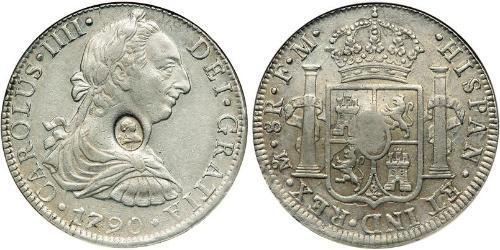
- Over 8,000,000 were counter-marked with a small head of George III. and circulated in England.
- The public however wanted coins of lesser value and struck or commissioned firms to strike tokens bearing their own names.
- For fourteen years there was no copper money coined in Britain or Ireland
- The heavy coinage (the so-called cartwheel pennies) of 1797 was melted down because the value, as old copper, was more than the fact, or indicated value of the pieces.
- The token coinage was however a great source of profit to the manufacturers and incidentally to many issuers.
- They were finally suppressed in England in the year 1817, by an Act of Parliament.
The shortage of good silver led to ‘clipping’ and it was reported in 1798 that shillings and sixpences were 25% and 38% respectively of their legal weight. This had major implications when someone brought a large amount of coin to bank for lodgement into their account.
- The Bank of Ireland refused to accept light coins at full value from Revenue Collectors despite strong Government requests, an early example of government pressuring the Bank to do its bidding
- There was a severe shortage of silver and gold, so the Mint didn’t issue many of these
- Between 1797 and 1804-05 the circulation of Irish notes increased by about 400% in contrast to 50% for the Bank of England
- With the Restriction the shortage of coin became more acute as gold and silver were shipped to Belfast and London to fetch higher prices, i.e. an arbitrage market had formed for bullion coins
- The shortage of small coins encouraged the issue of small denomination notes and early in the ‘The Year of the Restriction (1797) so-called “silver notes” began to appear. These were supposedly redeemable in silver but they “ … all too frequently appear to have been inconvertible even in terms of the debased silver coin”
- As well as these notes of dubious value, unlicensed traders began issuing I.O.U.s which were supposedly redeemable in goods. Naturally it was also a field day for forgeries of counterfeit notes and silver coin
This resulted in a constriction of economic activity as there was not enough coins circulating to facilitate economic transactions, so the ‘private sector’ had to take matters into its own hands… again! This time, the result was chaotic as a wide range of people got involved and not always for altruistic reasons.
- Like in the mid-17th century, commercial traders issued their own small ‘token’ coins as small change which could be used locally
- Some of the less scrupulous operators issued ‘truck’ or ‘scrip’ tokens to their employees which could only be used at their own shops – often at inflated prices, e.g.
- O’Brien Coin Guide: Truck/Scrip Tokens of Ballyglunin Estate, Co Galway
- A ‘criminal element’ issued ‘fakes’ which resulted in transportation to Australia for anyone caught using them
- O’Brien Coin Guide: The Irish-American ‘Voce Populi’ Token Coinage of 1760
- The smarter criminals issued ‘evasion halfpennies’ which got around the forgery laws, thus avoiding prosecution, e.g.
- O’Brien Coin Guide: Irish Evasion Halfpennies (1770s to the 1790s)
- The banks issued ‘small denomination banknotes’ to replace the silver coins that were not circulating
- Some local traders also issued ‘paper money’ of their own but these were little more than IOU’s, e.g. O’Brien Banknote Guide: The Killarney Bank, Co Kerry 1797–
- Local authorities also issued ‘paper money’ to facilitate small transactions on market days
- Early Irish Banknotes: Kinsale, Threepence Halfpenny
- Early Irish Banknotes: Kinsale, Threepence
- Local landlords opened small banks (known as ‘the silver banks’) and also issued small denomination tokens, e.g.
- Early Irish Banknotes: The Silver Bank, 3 shillings & nine-pence ha’penny
- Early Irish Banknotes: The Silver Bank, 6 shillings
- Some of the wealthier landlords/merchants issued their own silver coins, e.g.
- O’Brien Rare Coin Review: The Castlecomer Colliery Tokens
- And City corporations issued charity tokens (to alleviate the poor)
The result was catastrophic; good silver and official copper coinage was hoarded and 80% of the coins in circulation were underweight tokens and fakes known as ‘raps’ during the 1790s to the 1810s. The small denomination banknotes fared little better with many of the banks / private issuers going bankrupt and the people left with worthless paper in the pockets.
- A buyer had two choices: accept ‘dodgy coinage’ as change, or cancel the transaction
- A seller had two choices: give ‘dodgy coinage’ out as change, or face prosecution if he tried to lodge them in a bank
- Traders thus held on to the good coinage and banked it + kept the surplus ‘dodgy coinage’ as a float. The banks, in turn, held on to the ‘good coin’ and issued paper banknotes instead.
If enough people turned up at a bank and demanded ‘good silver or gold’ and the bank could not provide them with coin, there was ‘a run’ on that bank and it went out of business, leaving people out of pocket and its depositors out of pocket too.
- The smaller, under-capitalised banks, with fewer partners are the first to go and when they failed, they undermined public trust in banks, banking and paper money. Their owners were declared bankrupt and their assets seized. Money supply was further restricted.
Following the Act of Union, in 1801, the arbitrage market for Irish bullion coins eased but there was still a chronic shortage of coins in circulation. The newly formed Bank of Ireland, although not a central bank per se, was the Irish bank of last resort, so it had to buy silver on the international markets and issue its own tokens – it did not have the authority to issue coins of the realm.
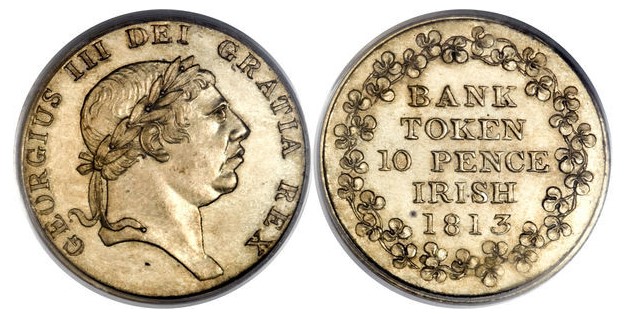
In an attempt to issue ‘good silver’ the Bank of Ireland imported silver from Europe and minted their own semi-official silver tokens, valued at 5 pence and 10 pence, respectively. They also issued a six-shilling token and were careful not to imitate denominations already used by The Royal Mint – otherwise they might have been accused of ‘coining’ or counterfeiting. This issuance of Bank of Ireland tokens somewhat alleviated the situation but it did not cure it completely – worse was to come later in the 19th C.
Private individuals also imported ‘good silver’ and, not wishing to be accused of ‘coining’ they simply counter-marked their coins and offered them as bullion pieces, valued by weight, e.g. the Anne, Duchess of Ormonde – the wife of the seventeenth Earl of Ormonde, John Butler in 1808 (or slightly later).
- Counter-marked “Payable at CASTLE-COMER COLLIERY, 5/5” on a Spanish Dollar
- O’Brien Rare Coin Review: The Castlecomer Colliery Tokens
- Other Irish counter-marks on Spanish Dollars include:
- Ob. GIBBONS bistruck & MD, Rv. J R in monogram
Others followed suit and counter-marked shillings, e.g O’Brien, O’Neill and O’Toole.
- Silver Countermarks on the obverse of shillings
- Obv. I.T. in a rectangle, Rv. W. R. & J. R. monogram
- Obv. O’BRIEN, Rev. MD.
- Obv. O’NEILL, Rev. M .
- Obv. O’TOOLE
- See Davis, W.J. “The Nineteenth Century Token Coinage of Great Britain, Ireland, the Channel Islands and the Isle of Man” (1904)
The situation did not change until ‘the recoinage and exchange of 1816-17’
- The Coinage Bill of 1816 was a turning point in monetary history, establishing Britain and Ireland on the gold standard and making provision for a major re-coinage and exchange of silver
- This involved exchanging the old coins in circulation for new ones and the problem was many of the older coins were in such poor condition (worn, damaged, under-weight) that the Bank of England would make a huge loss by replacing them
- There was huge opposition in government circles but they were conscious of the unhappy mood of the country in the summer of 1816 when William Wellesley Pole (Master of the Mint) described how
- “The citizens have lost all their feelings of pride and richness and flourishing fatness, trade is gone, contracts are gone, paper credit is gone, and there is nothing but stoppage, retrenchments and bankruptcy”.
- Pole explained to Parliament that the plan was to accept all coins of the realm however reduced they might be in weight, but with the proviso that ‘it could not be expected that base or foreign coin could be received in exchange for the new coin’.
- This still left a huge amount of worthless coins, unofficial tokens and counterfeits in circulation
- The public and traders would have to ‘take a loss’ on these.
- No coins were issued by Queen Anne (1702-14) for Ireland
- George I (1714-27) sold the rights to issue halfpennies to William Woods and these were rejected
- O’Brien Coin Guide: William Wood’s ‘Patent’ Irish Coinage (1722–1724) for George I
- George II (1727-60) reluctantly issued Irish farthings and halfpennies
- O’Brien Coin Guide: The Irish ‘Regal’ Coinage (1736-1760) of George II
- George III (1760-1820) issued halfpennies from 1776-82 and the so-called Soho Coinage (minted in Birmingham) in 1805 (farthings and halfpennies) and a penny (1822)
- O’Brien Coin Price Guide: The Irish Coinage of George III
- No Irish silver had been issued in over a century !
- Worn English silver and a large amount of foreign silver circulated in Ireland
- By the beginning of the 19th C, Ireland’s coinage was a mess (worn + under weight)
- Only an Act of Monetary Union could fix it !
- This finally happened in 1826/27


 The Old Currency Exchange is a specialist dealer and valuer of Irish & GB coins, tokens and banknotes