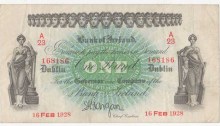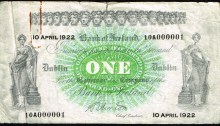
1928 Bank of Ireland. Dublin. One Pound. 16-FEB-1928 A23-168186, BH-1B, signed by Gargan. Good fine. The Old Currency Exchange, Dublin, Ireland.

Early Irish Banknotes: 1928 Bank of Ireland (Seventeenth Issue, Type 2) One Pound note

Date: 1928 Description: A Bank of Ireland Pound note (Seventeenth Issue), Type 2 (last Dublin issue) Issued on 16th February 1928 Serial Number: A23-168186 (in red) Signed by: Joseph A. Gargan, Chief Cashier Obverse: The £1 note of this 17th issue of the Bank of Ireland series features A blue-green underprint with a green oval…

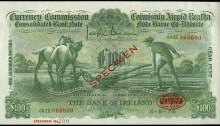
£100 ploughman, Bank of Ireland, One Hundred Pounds, specimen 1978 obverse. The Old Currency Exchange, Dublin, Ireland.

O’Brien Banknote Price Guide 2016: Ploughman £20, £50 and £100 notes (Specimens, Colour Trials & Proofs)

Withdrawal from Circulation: According to Central Bank of Ireland records, all £20, £50 and £100 ‘ploughman’ notes were successfully withdrawn from circulation, i.e. there are no ‘circulating’ examples left for collectors to collect. That said, the remaining £1, £5 and £10 ‘ploughman’ notes aren’t exactly common nowadays either – as per table below: Estimated Number…

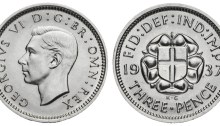
1937 GB & Ireland silver threepence (George VI). The Old Currency Exchange, Dublin, Ireland.

O’Brien Coin Guide: GB & Northern Ireland Silver Threepence of George VI

Introduction: In 1936, Edward VIII produced a stunning new set of designs for British coinage and, in addition to producing a new ‘brass’ threepence, his proposed silver threepence featured the three rings of St Edward on the reverse. Between the death of his father, George V, and his planned coronation King Edward VIII abdicated and…

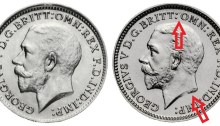
Spot the difference between the 'normal' and 'modified' effigy on the 1926 GB & Ireland Threepence. The Old Currency Exchange, Dublin, Ireland.

O’Brien Coin Guide: GB & Ireland Silver Threepence of George V, Part 2

Introduction: The silver threepences of George V are very popular amongst collectors and are readily available in coin dealers’ bulk boxes, and at coin fairs, exhibitions and car boot sales. There are four different types of George V threepence. Type 1: Sterling Silver issues (1911-1920) is dealt with separately. The three types dealt with in…

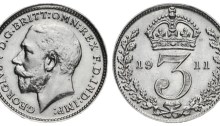
1911 GB & Ireland silver threepence (George V). The Old Currency Exchange, Dublin, Ireland.

O’Brien Coin Guide: GB & Ireland Silver Threepence of George V, Part 1

Introduction: The silver threepences of George V are very popular amongst collectors and are readily available in coin dealers’ bulk boxes, and at coin fairs, exhibitions and car boot sales. The first type (sterling issues) are much softer than their later (50% silver) counterparts and wear more easily, thus coins in the higher grades are…

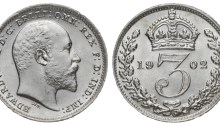
1902 Edward VII silver threepence

O’Brien Coin Guide: GB & Ireland Silver Threepences of Edward VII

Introduction: The silver threepences of Edward VII are very popular amongst collectors and a full set set is relatively easy to complete. There are no major varieties and even the silver proof of 1902 is readily available. Silver Threepence: Edward VII Alloy: Sterling Silver (92.5% silver) Weight: 1.41g Diameter: 16mm Edge: Plain Obverse: Bare head…

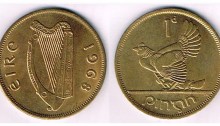
1968 Irish penny flan error E16i - struck in nickel-brass instead of bronze, with a copy of a letter, dated 3rd April 1975, from Royal Mint confirming it was an error. Very rare, uncirculated.

O’Brien Coin Guide: Irish Pre-Decimal Penny Errors & Varieties

Introduction: This post is a continuation of the research work done by Derek Young and Prof. G.F. Mitchell – first published in the Irish Numismatics magazine. Sadly, this excellent magazine is no longer available and quite difficult to source. The information in this post relates to ‘minting errors’ on Irish pre-decimal pennies. According to a…

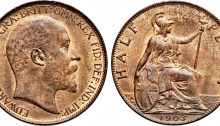
1903 GB & Ireland - Bronze Halfpenny - Edward VII. The Old Currency Exchange, Dublin.

O’Brien Coin Guide: GB & Ireland Bronze Halfpennies of Edward VII

Background: Edward VII’s reign was short and, from a numismatic viewpoint, relatively uneventful. He embarked on a goodwill tour (Royal Visit) of Ireland in 1902 and, despite the good press he received, Irish nationalism continued to grow. His bronze halfpennies were a continuation of Victorian designs, although the numbers minted were considerably higher than in…

1916 GB & Ireland bronze halfpenny (George V). The Old Currency Exchange, Dublin.

O’Brien Coin Guide: GB & Ireland Bronze Halfpennies of George V

Background: George V’s reign was a turbulent one for Ireland and a very exciting for Irish numismatics – the highlight being a new Irish currency in 1928. After independence, Ireland continued to use GB & Ireland coins and banknotes. Despite the popularity of the new Irish currency, the coinage of GB & Northern Ireland persisted…

1944 GB & Northern Ireland George VI bronze halfpenny

O’Brien Coin Guide: GB & Northern Ireland Bronze Halfpennies of George VI

Background: George VI’s reign included the economically disastrous Word War II which culminated in his overseeing the dismantling of the British Empire to the point where it had to be transformed into a weaker / less cohesive British Commonwealth. The biggest loss was the independence and breakup of India into three nation states – India,…