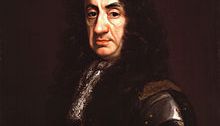
Portrait of King Charles II, by John Riley

Proclamation of Charles II, 1672 (making current Royal Farthings and Halfpennys)

Proclamation of Charles II, Issued 16 August 1672 Making Current the Royal Farthings and Halfpennys and Forbidding the Use of All Others By the King. A Proclamation for making currant His Majestie’s Farthings and Half-pence of Copper, and forbidding all others to be used. Charles R. Whereas of late years several Persons and Corporations, upon…

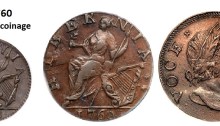
Cork, under Commonwealth authority, Farthing token, overstruck on a Double Tournois of Louis XIII

The Proliferation of Unofficial Irish ‘Farthing Tokens’ in the 17th Century

By the first half of the 17th C, the copper coinage in both Britain and Ireland was in complete disarray. Neither James I nor his son, Charles I, took much interest in providing small denominations and ‘farmed out’ the Royal prerogative of minting copper coins to ‘favourite’ courtiers as patentees – Lords Harington, Richmond, Lennox and Maltravers were the principal…

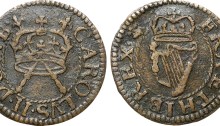
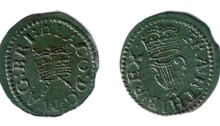
The Irish Armstrong farthing legend reads as follows :- CAROLVS II D G M B FRA ET HIB REX which translates and expands to :- Charles II by the grace of God, King of Great Britain, France and Ireland

O’Brien Coin Guide: Armstrong’s ‘Patent’ Irish Farthings (1660-61) for Charles II

Upon his restoration to the crown in 1660, King Charles II granted a patent to Sir Thomas Armstrong to ‘coin farthings’ for the next twenty years and all other (unofficial) farthings were to be prohibited.   In 1661, two royal proclamations were issued prohibiting the issuing and use of brass or copper tokens In 1662,…

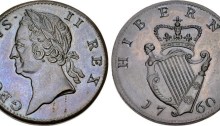
1760 George II (1727-1760), Copper Halfpenny, Type IV

O’Brien Coin Guide: The Irish ‘Regal Coinage’ of George II (1736-1760)

George Augustus was King of Great Britain & Ireland, Duke of Brunswick-Lüneburg (Hanover) and Prince-elector of the Holy Roman Empire from 11th June 1727 until his death on 25th October 1760. Both of George’s parents committed adultery In 1694 their marriage was dissolved on the pretext that Sophia had abandoned her husband She was confined to Ahlden House and…

Wood's Irish coinage, Ireland, Dean Swift, Numismatic, coin, farthing, halfpenny

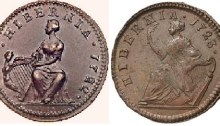
O’Brien Coin Guide: William Wood’s Irish Coinage (1722-1724) for George I

William Wood was the owner of several copper and tin mines in England and he hoped to make a large profit via the production of coins for use in Ireland and America.  During the first half of 1722 King George I’s mistress (who had followed him over from Germany), the Duchess of Kendal, obtained a…

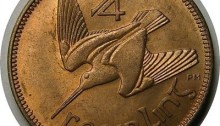
1928-66 Irish Farthing (reverse design)

O’Brien Coin Guide: Irish Pre-Decimal Farthing

Ireland is one of only four nations to issue farthing coins in the 20th century.  The other three countries to circulate farthings were the UK (1900-1956), South Africa (1923-60), and Jamaica (1900-63). British farthings ceased to be legal currency in 1960 The farthings of South Africa, Jamaica and Ireland ceased to be legal currency in 1961, 1969…