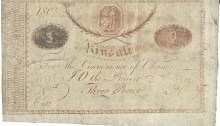
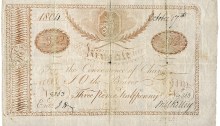
180_ Kinsale (Corporation), Threepence (for the convenience of change). The Old Currency Exchange, Dublin, Ireland.

Irish Banknote Guide: 180(4) Kinsale Corporation (3d note)

Date: c.1804 Few people had silver or gold coins, and those who did, hoarded them and did not use them unless they really had to. Most of the smaller change in circulation was unofficial, illegal tokens. In short, there was a local currency crisis. The solution was small notes (an IOU) like the one below…
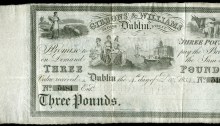
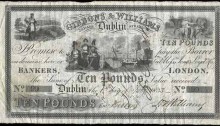
1834 Dublin, Gibbons & Williams Bank, Three Pounds, 4 December 1834, no. 5484, unissued, with counterfoil (PB 159). The Old Currency Exchange, Dublin, Ireland.

O’Brien Banknote Guide: Gibbons & Williams Bank, Dublin (1833-1835)

Introduction: The short-lived Gibbons & Williams Bank issued some of the most attractive banknotes of the period – being printed on both sides and featuring many beautiful vignettes of Dublin and agricultural themes. As such, they are highly sought after by collectors. Their one pound, thirty shilling and three pound notes were payable in Dublin…

1833 £10 Gibbons & Williams, Dublin, S/N 99, dated 1st July 1833 and signed by Hutchins Thomas Williams. The Old Currency Exchange, Dublin, Ireland.

Irish Banknote Guide: Ten Pounds (Gibbons & Williams’ Bank) 1833

Gibbons & Williams Bank: Gibbons & Williams was one of the last private banks to be founded in Ireland. Founded in 1833, it spectacularly collapsed in 1835 when the senior partner, Hutchins Thomas Williams, was found to have been embezzling client funds. James Gibbons had parted company with him in 1834 and wasn’t involved in…

1833 £5 Gibbons & Williams, Dublin, S/N 1042, dated 1st September 1833. The Old Currency Exchange, Dublin, Ireland.

Irish Banknote Guide: Five Pounds (Gibbons & Williams’ Bank) 1833

Gibbons & Williams Bank: Gibbons & Williams was one of the last private banks to be founded in Ireland. Founded in 1833, it spectacularly collapsed in 1835 when the senior partner, Hutchins Thomas Williams, was found to have been embezzling client funds. James Gibbons had parted company with him in 1834 and wasn’t involved in…

1834 Dublin, Gibbons & Williams Bank, Three Pounds, 4 December 1834, no. 5484, unissued, with counterfoil (PB 159). The Old Currency Exchange, Dublin, Ireland.

Irish Banknote Guide: Three Pounds (Gibbons & Williams’ Bank) 1834

Gibbons & Williams Bank: Gibbons & Williams was one of the last private banks to be founded in Ireland. Founded in 1833, it spectacularly collapsed in 1835 when the senior partner, Hutchins Thomas Williams, was found to have been embezzling client funds. James Gibbons had parted company with him in 1834 and wasn’t involved in…

1818 Kilkenny Bank, Five Pounds Sterling, dated 11 November 1818, for James Loughnan, signed by him. The Old Currency Exchange, Dublin, Ireland.

Early Irish Banknotes: Five Pounds Stg., The Kilkenny Bank (Loughnan’s Bank) 1818

The Kilkenny Bank / Loughnan’s Bank: The Kilkenny Bank was first registered in 23rd September 1800, by Connel Loughnan and John Helsham. There was three sets of notes issued: Type 1 Signatories: Kilkenny Bank (Connel Loughnan and John Helsham) Type 2 Signatories: Kilkenny Bank (Michael Brennan and James Loughnan) Type 3 Signatories: Kilkenny Bank (James…

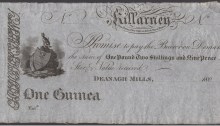
c. 1804 Deenagh Mills, Killarney, One Guinea (One pound, two shillings & ninepence)

Early Irish Banknotes: Killarney, Deanagh Mills (One Guinea) 180_ (un-issued)

Deanagh Mills Tradesman’s Note This establishment was never registered as a ‘bank’ per se and, as a result, its notes are listed as a Tradesman Issue in the Paper Money of Ireland catalogue. That said, their banknotes were produced to a high standard and the surviving banknotes (usually un-issued) are of good quality and usually…