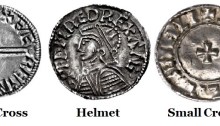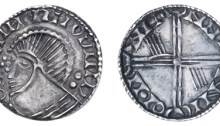
There are five main classes of coins in the Hiberno-Norse, Phase I series

O’Brien Rare Coin Guide: Hiberno-Norse, Phase 1 (AD 995–1018)

Introduction The first phase of the Hiberno-Norse coinages were imitations of contemporary Anglo-Saxon coins. They were produced in Dublin but closely copied the style of the silver pennies of Aethelred II of England and his successor Cnut. Since the English coin designs changed periodically, the dating and sequence of their Hiberno-Norse equivalents can be identified…

Cork, under Commonwealth authority, Farthing token, overstruck on a Double Tournois of Louis XIII

The Proliferation of Unofficial Irish ‘Farthing Tokens’ in the 17th Century

By the first half of the 17th C, the copper coinage in both Britain and Ireland was in complete disarray. Neither James I nor his son, Charles I, took much interest in providing small denominations and ‘farmed out’ the Royal prerogative of minting copper coins to ‘favourite’ courtiers as patentees – Lords Harington, Richmond, Lennox and Maltravers were the principal…

Wood's Irish coinage, Ireland, Dean Swift, Numismatic, coin, farthing, halfpenny

O’Brien Coin Guide: William Wood’s Irish Coinage (1722-1724) for George I

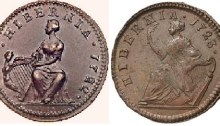
William Wood was the owner of several copper and tin mines in England and he hoped to make a large profit via the production of coins for use in Ireland and America.  During the first half of 1722 King George I’s mistress (who had followed him over from Germany), the Duchess of Kendal, obtained a…

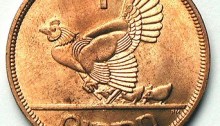
How to identify the Irish chickless penny variety ireland coins coinage

O’Brien Coin Guide: How to identify the Irish “Chickless” Penny Variety

The ‘chickless’ variety is probably a die flaw caused by normal ‘wear and tear’ on the dies during the minting process.  This variety has become very popular with collectors over the past decade and some claim to have evidence of “progressive wear across several examples of 1968 pennies” leading to a chickless coin. The most…

Phase III, Penny, bust left, two pellets in front of face and behind head, rev. long voided cross with hand in two quarters, blundered legends

O’Brien Coin Guide: Introduction to the Hiberno-Norse Coinages of the Late 10th & Early 11th C

The first locally produced Irish coinage was the so-called Hiberno-Norse coinage which was first minted in Dublin in about 995-7 AD under the authority of Sihtric III (aka Sihtric Silkenbeard), the Norse King of Dublin.  There is no evidence for the native Irish producing coins before this, so it is likely that their economy was not coin-based.  The…

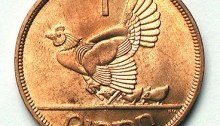
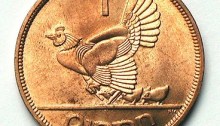
1928-68 Irish Penny (reverse design)

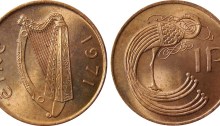
O’Brien Coin Guide: Irish Pre-Decimal Penny

The penny (1d) (Irish: pingin) coin was the third smallest denomination of the pre-decimal Irish pound.  There were 12 to a shilling, 24 to a florin and 240 to a pound.  To express an amount, penny was abbreviated to “d”, e.g. shortened from dwt, or pennyweight. The penny is one of the longest circulating coin denominations in Europe –…

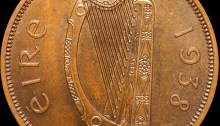
O’Brien Rare Coin Review: Why is the 1938 Irish Penny so valuable?

In 1937, a new constitution declaring Ireland a free state was established and the old designs for the coins of Ireland that featured the legend “Saorstat Eireann” or Irish Free State were changed to “Eire” to reflect the new constitution. The only known 1938 coins to feature that revised legend are: one halfcrown (currently unique…