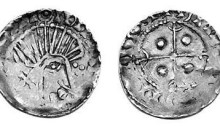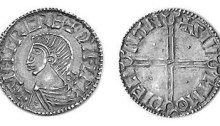
An Hiberno-Norse Phase II Long Cross Penny, Sihtric of Dublin, with Dublin mint signature of Siult (Moneyer of Dublin). The Old Currency Exchange, Dublin, Ireland.

Irish Coin Daily: Hiberno-Norse Phase II Silver Penny, Sihtric of Dublin (Moneyer: SIULT)

Date: c. 1015-1035 Description: An Hiberno-Norse Phase II Long Cross Penny, Sihtric of Dublin, with Dublin mint signature of Siult (Moneyer of Dublin). Diameter: 19mm Extremely fine (EF), pretty much as struck RARE in any grade, but extremely rare in this high grade References: S.6122 Obverse: Draped bust left; cross behind neck Legend: + YHTRE:…
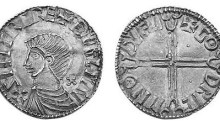
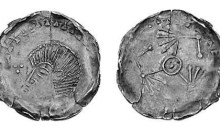
An Hiberno-Norse Phase II Long Cross Penny, Sihtric of Dublin, with Dublin mint signature of Godric (Moneyer of Dublin). The Old Currency Exchange, Dublin, Ireland.

Irish Coin Daily: Hiberno-Norse Phase II Silver Penny, Sihtric of Dublin (Moneyer: GODRIC)

Date: c. 1015-1035   Description: An Hiberno-Norse Phase II Long Cross Penny, Sihtric of Dublin, with Dublin mint signature of Godric (Moneyer of Dublin). Diameter: 19mm Extremely fine (EF), pretty much as struck Extremely rare in such a high grade References: S.6122 Obverse: Draped bust left; poorly executed quatrefoil behind neck Legend: + SIHTRC: REX:…

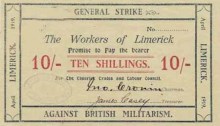
Extremely rare Limerick Soviet Ten Shillings Note. Printed in Black & Red inks, on Cream paper. Signed by John Cronin (Chairman) and James Casey (Treasurer). Not numbered / likely not issued. The Old Currency Exchange, Dublin, Ireland.

Irish Banknote Guide: Limerick Soviet, Ten Shillings (10/- Black & Red, on Cream Paper)

Date: 1919 (April 15-27) Description: Extremely rare Limerick Soviet Ten Shillings Note Printed in Black & Red inks, on Cream paper. Signed by John Cronin (Chairman) and James Casey (Treasurer). Not numbered / likely not issued Notes: There are five Types of Limerick Soviet notes, as follows: A1. Signatures John Cronin, Chairman; James Casey, Treasurer.…

Extremely rare Limerick Soviet Five Shillings Note - Type A1. Printed in Black & Green inks, on Grey-blue paper. Signed by John Cronin (Chairman) and James Casey (Treasurer). The Old Currency Exchange, Dublin, Ireland.

Irish Banknote Guide: Limerick Soviet, Five Shillings (5/- Black & Green, on Grey-blue paper)

Date: 1919 (April 15-27) Description: Extremely rare Limerick Soviet Five Shillings Note – Type A1 Printed in Black & Green inks, on Grey-blue paper. Signed by John Cronin (Chairman) and James Casey (Treasurer). Notes: There are five Types of Limerick Soviet notes, as follows: A1. Signatures John Cronin, Chairman; James Casey, Treasurer. Notes Stamped and…

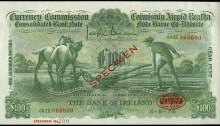
£100 ploughman, Bank of Ireland, One Hundred Pounds, specimen 1978 obverse. The Old Currency Exchange, Dublin, Ireland.

O’Brien Banknote Price Guide 2016: Ploughman £20, £50 and £100 notes (Specimens, Colour Trials & Proofs)

Withdrawal from Circulation: According to Central Bank of Ireland records, all £20, £50 and £100 ‘ploughman’ notes were successfully withdrawn from circulation, i.e. there are no ‘circulating’ examples left for collectors to collect. That said, the remaining £1, £5 and £10 ‘ploughman’ notes aren’t exactly common nowadays either – as per table below: Estimated Number…

Harthacnut, Penny, 1.06g, Scandinavian imitation in the style of a Hiberno-Norse long cross, Lund mint, +hardÐa cvnvc, bare bust left to base of coin, rev. +Ðorcetl on lv, long cross, each limb ending in three semicircles, a pellet in centre (cf. S.6103), crude, peck marks to the reverse, very fine, extremely rare

Irish Coin Daily: Scandinavian Imitation of an Hiberno-Norse, Phase I, Class B (Long Cross) Penny – Harthacnut / Lund Mint

Date: 1040-1046 ? Description: Harthacnut, Penny, 1.06g, Scandinavian imitation in the style of a Hiberno-Norse long cross, Lund mint. Peck marks to the reverse. A crude but recognisable imitation of an Hiberno-Norse, Phase 1, Class B penny (S.6103) itself imitating a penny of Harthacnut. Very fine (VF) Extremely rare Obverse: Bare bust left to base…

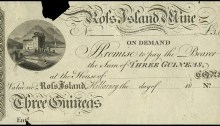
18__ Killarney, Ross Island Mine, Three Guineas, 18–, uniface proof on paper. The Old Currency Exchange, Dublin, Ireland.

O’Brien Banknote Guide: Ross Island Mine (Killarney) 1804-c.1819

Introduction: The history of mining at Ross Island in Killarney, Co Kerry, can be traced back to the Bronze Age, where several ancient metal finds from Killarney point to a significant Early Bronze Age settlement in the area. The Bronze Age Workings: The Bronze Age work camp at Ross Island provides an insight into daily…

Hiberno-Norse c 1065-1095 Penny Phase V coinage, Crude bust right, derivative of Edward the Confessor small flan type. The Old Currency Exchange, Dublin, Ireland.

Irish Coin Daily: Hiberno-Norse Phase V Silver Penny (Crude bust right, derivative of Edward the Confessor small flan type)

Date: c. 1065 – 1095 Description: Hiberno-Norse coinage, silver penny, Phase V coinage – Crude bust right, derivative of Edward the Confessor small flan type. Toned good very fine (gVF) Extremely RARE Obverse: Crude bust right, derivative of Edward the Confessor Blundered and illegible legend around Reverse: Bow cross, large pellets in angles Blundered and illegible…

Hiberno-Norse Silver Penny, Phase V mule, crude bust left, trefoil of pellets to left (S.6139) + three birds around central pellet (S.6169). The Old Currency Exchange, Dublin, Ireland.

Irish Coin Daily: Hiberno-Norse Phase V Silver Penny Mule (crude bust left, trefoil of pellets to left (S.6139) + three birds around central pellet (S.6169)

Date: c. 1080 – 1085 Description: Hiberno-Norse coinage, silver penny mule, Phase V coinage. Diameter: 17mm Weight: c. 0.7g. Good very fine (gVF), with some surface cracks and flat areas Obverse: Crude bust left, trefoil of pellets to left (S.6139) Blundered and illegible legend around Reverse: Three birds around central pellet (S.6169) Blundered and illegible legend…

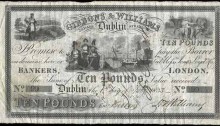
1833 £10 Gibbons & Williams, Dublin, S/N 99, dated 1st July 1833 and signed by Hutchins Thomas Williams. The Old Currency Exchange, Dublin, Ireland.

Irish Banknote Guide: Ten Pounds (Gibbons & Williams’ Bank) 1833

Gibbons & Williams Bank: Gibbons & Williams was one of the last private banks to be founded in Ireland. Founded in 1833, it spectacularly collapsed in 1835 when the senior partner, Hutchins Thomas Williams, was found to have been embezzling client funds. James Gibbons had parted company with him in 1834 and wasn’t involved in…