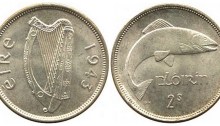
O’Brien Rare Coin Review: Why is the 1943 Irish Florin so valuable?
Introduction The 1943 florin is the rarest ‘modern’ Irish coin to have actually circulated. The 1985 Irish 20p was not intended to circulate The 1992 Irish 10p was not intended to circulate Both of the coins listed above were minted for only testing purposes, i.e. to calibrate vending machines and they were supposed to have…
O’Brien Coin Guide: Irish Pre-Decimal Florin
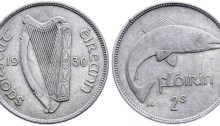
The florin (2s or 2/-) coin was a sub-division of the pre-decimal Irish pound, worth 1/10 of a pound. It was more commonly known as the two-shilling coin. The reverse design featuring a salmon was by English artist Percy Metcalfe. The obverse featured the Irish harp. From 1928 to 1937 the date was split either…
O’Brien Coin Guide: William Wood’s Irish Coinage (1722-1724) for George I
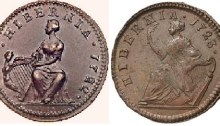
William Wood was the owner of several copper and tin mines in England and he hoped to make a large profit via the production of coins for use in Ireland and America. During the first half of 1722 King George I’s mistress (who had followed him over from Germany), the Duchess of Kendal, obtained a…
Dean Swift & Drapier’s Letters
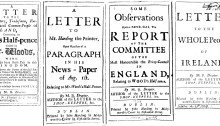
In 1722, the ‘hardware’ manufacturer William Wood was granted a patent to produce copper coins to the maximum cash value of up to £108,000 for use in Ireland. At 48 farthings or 24 halfpennies to one silver shilling, this was a lot of ‘loose change’ At 960 farthings or 480 halfpennies to the pound, £108,000 was…
O’Brien Coin Guide: Irish Pre-Decimal Halfcrown
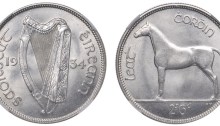
The half-crown (2s6d or 2/6) coin was a subdivision of the pre-decimal Irish pound, worth 1/8 of a pound. The halfcrown was commonly called “two and six” due to its value of two shillings and sixpence (indicated on the coin itself as ‘2s6d’). For almost half a century it was the largest circulating Irish coin…
O’Brien Coin Guide: Irish Pre-Decimal Shilling
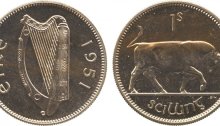
The shilling (often written as 1s or 1/-) coin was a sub-division of the pre-decimal Irish pound, and was worth 1/20th of a pound. The original issue of the coin from 1928 until 1942 contained 75% silver; thus this Irish coin had a higher content than the equivalent British coin. These earlier coins were noticeably different…
Infamous Irish Banks: The Agricultural & Commercial Bank (1834-1836)
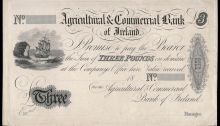
1834-36: Major Banking Expansion In Ireland The short-lived Agricultural & Commercial Bank of Ireland was founded in 1834, suspended payments in 1836 and struggled on until 1840. It was the first Joint-Stock Bank in Ireland to fail but it was not its failure (in itself) that made headlines but the manner of its failure. When…
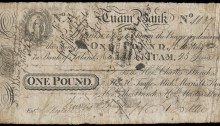
Infamous Irish Banknotes: Lord ffrench & Co (Tuam & Dublin)
ffrench’s Bank was probably, the most famous of the provincial private banks in Ireland and due to the frequency that they turn up at auction, they are amongst the most collectible of early Irish banknotes. The bank was founded in late 1803 by Sir Thomas ffrench and William Keary. The correct form for the surname is “double f” in lower case, i.e. ffrench. Sir…
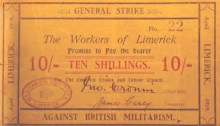
Rare Irish Banknotes: the Limerick “Soviet” of 1919
During the Irish War of Independence, the City of Limerick was very unusual insofar as it issued its own currency – a series of low denomination banknotes. It is the only instance of a labour organisation doing so, not on in Ireland but also throughout the UK. It is the first physical sign in a…
 The Old Currency Exchange is a specialist dealer and valuer of Irish & GB coins, tokens and banknotes