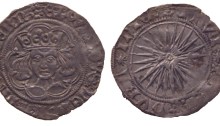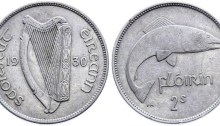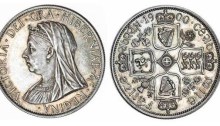
Edward IV 1467 Irish double groat, sun & roses coinage, Dublin mint

Edward IV issues Irish coins of a lower standard (1467)

Introduction: Realising that having an Irish currency equal to English standard weights resulted in a massive drain of silver out of Ireland and, consequently, reducing the amount of coinage in circulation + causing a recession, Edward IV moved towards remedying this by announcing a new (lower intrinsic value) coinage for Ireland in 1467: double-groats (eight…

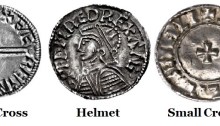
There are five main classes of coins in the Hiberno-Norse, Phase I series

O’Brien Rare Coin Guide: Hiberno-Norse, Phase 1 (AD 995–1018)

Introduction The first phase of the Hiberno-Norse coinages were imitations of contemporary Anglo-Saxon coins. They were produced in Dublin but closely copied the style of the silver pennies of Aethelred II of England and his successor Cnut. Since the English coin designs changed periodically, the dating and sequence of their Hiberno-Norse equivalents can be identified…

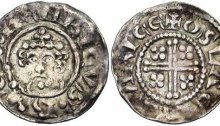
Henry II of England, Short Cross Class 1B Penny, Moneyer Oslac of Worcester

O’Brien Coin Guide: Why did Henry II not issue coins for Ireland?

Background Henry’s Troubled Succession Henry was born in France at Le Mans on 5 March 1133 as the eldest child of Geoffrey the Fair, Count of Anjou, and the Empress Matilda, so titled because of her first marriage to Henry V, the Holy Roman Emperor. Henry’s mother was a very powerful woman: She was the…

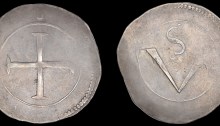
Charles I (1625-1649), Confederate Catholics, ‘Rebel Money’, Crown, mm. pellet

O’Brien Rare Coin Review: Confederate Catholic Coinage of 1642-43 (Kilkenny/Rebel Money)

Introduction In the older literature, these coins are referred to as ‘Kilkenny Money’ but are now, more properly referred to as ‘Confederated Catholic Coinage’ or ‘Rebel Money.’ There are two opinions re who actually these enigmatic coins – one thinks they might have been minted by the Catholic Confederacy in Kilkenny from as early as September 1642…