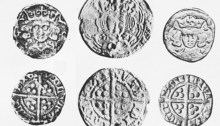
IRELAND. Edward IV. First reign, 1461-1470. AR Groat (26mm, 2.40 g, 1h). Heavy ‘Cross and Pellets’ coinage. Dublin mint; im: pierced cross fitchy. Struck 1465. + ЄDWΛRDVS : DЄI : GRΛ : DnS : ҺУBЄRnIЄ (double saltire stops), crowned facing bust within tressure of arches, with inward facing lis on cusps, pellets in three lower spandrels / + POSVI [DЄV]m : Λ DIVTOR • Є mЄVm/ CIVI TΛS DVBL InIЄ (pellet and double saltire stops), long cross pattée with trefoils in angles, additional pellets in second and third angles. SCBI 22 (Copenhagen), –; D&F 133; SCBC 6291. VF, toned, edge splits.

Irish Coin Daily: Silver Groat of Edward IV, Heavy Portrait ‘Cross & Pellets’ coinage (Dublin mint) 1465-66

Date: c. 1465-66 Description: Edward IV. First reign, 1461-1470. Silver Groat (26mm, 2.40 g, 1h). Heavy Portrait ‘Cross and Pellets’ coinage. Dublin mint; im: pierced cross fitchy. SCBI 22 (Copenhagen), –; D&F 133; SCBC 6291. Very Fine (VF) Toned, edge splits Obverse: Crowned facing bust within tressure of arches, with inward facing lis on cusps, pellets in three…

Ireland. Henry VII (1485-1509) AR Groat. Dublin, c.1485-1487. [RЄX] ΛnGL IЄ FRΛ nC[IЄ], coat of arms over long cross with triple pellet ends / [DOmI] nVS hУBЄ RnIЄ, three crowns over long cross with triple pellet ends. S 6415. 1.92g, 22mm, 11h. Good Very Fine. Of exceptional quality and visual appeal.

Irish Coin Daily: Silver Groat of Henry VII (1485-1509), Dublin Mint

Date: c. 1485-1487 Description: Henry VII Silver Groat. Dublin mint, c.1485-1487. [RЄX] ΛnGL IЄ FRΛ nC[IЄ], coat of arms over long cross with triple pellet ends / [DOmI] nVS hУBЄ RnIЄ, three crowns over long cross with triple pellet ends. S 6415. 1.92g, 22mm, 11h. Good Very Fine (gVF) Of exceptional quality and visual appeal. Country: Ireland…

Ireland. Elizabeth I (1558-1603) BI Groat. Dublin, c.1558. ELIZA[B]ETA D’·G’·ANG’·FRA’·Z·HI, crowned and mantled bust left / POSVI:DEVM:ADIVTOREM:MEVM ·, crowned harp; crowned E R to left and right. S 6504. 3.04g, 25mm, 3h.

Irish Coin Daily: Billon Groat of Elizabeth I. Dublin (1st Irish Coinage) “REGI.”

Date: c. 1558 Description: Elizabeth I Billon Groat. Dublin, c.1558 Weight: 3.04g Diameter: 25mm Reference: S 6504 Very Fine (VF) Obverse: Crowned and mantled bust, facing left Legend: ELIZA[B]ETA D’·G’·ANG’·FRA’·Z.·HIB. REGI. Translation: “Elizabeth by the Grace of God, Queen of England, France and Ireland” Reverse: Crowned harp; crowned E R to left and right Legend: POSVI:…

Ireland, Philip and Mary, groat, 155[7], mm. rose, date lacks last digit, facing busts, crown above, date below, rev. crowned harp (S.6501B)

Irish Coin Daily: Silver Groat of Philip & Mary, 155[7]

Date: c. 155[7] Description: Ireland, Philip and Mary, groat, 155[7], mm. rose, date lacks last digit, facing busts, crown above, date below, rev. crowned harp (S.6501B), Obverse, Fine (F) Reverse, Very Fine (VF) Country: Ireland Category: Anglo-Norman House of Tudor Philip of Spain & (Bloody) Mary I (1553-1558) the only child of King Henry VIII and his first…

Ireland, Henry VIII, First Harp Issue (1534-40), groat, m.m. crown, crowned h and i (for Henry and Jane Seymour, 1536-37) beside harp, 2.45g (S. 6473), good very fine

Irish Coin Daily: Groat of Henry VIII & Jane Seymour, First Harp Issue (1534-40)

Date: c. 1536-37 Description: Ireland, Henry VIII, First Harp Issue (1534-40), groat, m.m. crown, crowned “H” and “I” (for Henry and Jane Seymour, 1536-37) beside harp, 2.45g (S. 6473) Good very fine (GVF) Country: Ireland Category: Anglo-Norman House of Tudor Henry VIII Jane Seymour Hammered Additional Information: Jane Seymour (c. 1508 – 24 October 1537) Queen of England from…

O'Reilly Money - Edward III, pre-Treaty issues, London mint, ex Grainger coll., wts. 29.6, 29.1 and 28.8 grains

O’Brien Rare Coin Review: O’Reilly’s Money (1447-1459)

Introduction: The much debated O’Reilly’s Money is often quoted in old Irish numismatic books and society papers. However, examples are very rare and few collectors seemed interested enough in them to add them to their cabinets in the early days of Irish numismatics. Most examples are hidden away in museum collections and rarely see the…

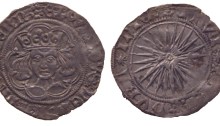
Edward IV 1467 Irish double groat, sun & roses coinage, Dublin mint

Edward IV issues Irish coins of a lower standard (1467)

Introduction: Realising that having an Irish currency equal to English standard weights resulted in a massive drain of silver out of Ireland and, consequently, reducing the amount of coinage in circulation + causing a recession, Edward IV moved towards remedying this by announcing a new (lower intrinsic value) coinage for Ireland in 1467: double-groats (eight…

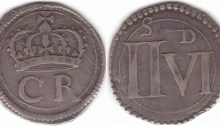
Ormonde Halfcrown. S.6545. Obv. Crown above C and R, a line circle around, and a somewhat crude blunt toothed outer border. Only cross of crown touches the inner line circle. Only the tail of the trailing R crosses the circle. A faint triangular pellet divides the C and R. The C has a near Roman top seraph, and no bottom seraph. Rev. Huge bold II, height 15.0mm, and shorter VI, height 11.3mm. All four corners of the IIVI cut across the inner line circle of 25.5mm diameter. Minute central pellet before V. An almost snakelike S with almost parallel Roman seraphs is centered above the II, and almost bisected by the line circle with bottom of top seraph of S just touching the outside of the inner circle. Well formed D, height 3.6mm, with a longer top seraph than bottom seraph, is above right side of V and closer to circle than to the V. Struck on an unusually round sterling plate flan, still showing part of original silver detail on obverse

O’Brien Coin Guide: The Ormonde Money of 1643-44

Introduction The 1642 ‘Lords Justices’ issues were followed in 1643 by a larger (fourth) emergency issue of better made, but still crude, silver coins. These are collectively known as ‘Ormonde Money’ since they were issued by the Lord Justice, the Earl of Ormonde (James Butler) some time between 1643-1644. Ormonde’s active career began in Ireland had begun…

Duke of Ormonde’s gold coinage of 1646-7, Pistole, Dublin, undated, stamped 4dwt 7grs both sides

O’Brien Coin Guide: Introduction to the Emergency Coinages of the Great Rebellion of 1641-52

Introduction Many people think of the Great Rebellion as a two-sided fight – the Irish Catholics versus the Anglo-Irish Protestants … but it was a lot more complicated than that. There were at least five opposing parties during the rebellion, which have been described by Carlyle as follows :- the Catholics of the Pale demanding…